Last updated: 21st Aug 2026
How much content do top-ranking e-commerce category pages really have? [2025 Study].
 By James Brockbank, Managing Director & Founder
Get weekly SEO insights straight to your inbox.
Sign up to outranked, our weekly SEO newsletter
How much content should you put on an eCommerce category page?
It’s one of the longest-running debates in eCommerce SEO, and one I’ve been discussing a lot lately.
Over the last few months, I’ve had multiple conversations with eCommerce brands who’ve seen rankings drop for key category-level terms. In almost every case, my recommendation has been the same: “Your category pages contain too much text.”
More content doesn’t automatically make a page more relevant to the query.
In fact, it can often make it less relevant, especially when a category page starts to resemble a buying guide with a product grid tacked on top. That’s not the right intent for a commercial query.
I wanted to put some data behind this, so I analysed 300 eCommerce category pages ranking #1 on Google UK for commercial-intent keywords. The aim wasn’t to prove that word count directly affects rankings, but to see what top-ranking pages are actually doing in practice.
The findings?
The average #1-ranked category page contains just 310 words of unique content.
The research in 30-seconds:
- The “ideal” word count for eCommerce category pages is much lower than many think. Across 300 top-ranking UK eCommerce category pages, the average unique text content was just 310 words, with 66% of pages under 400 words and 44% under 200. This shows you don’t need long-form copy to rank well.
- Relevance beats volume every time. Top pages focus on content that helps a shopper quickly choose and buy, not on stuffing the page with filler text or “what is [X]” explanations. If your copy could appear on a competitor’s page without change, it’s too generic.
- Household name brands can sometimes get away with less; most can’t. 10% of the top category pages had no content outside the H1, but most of these belonged to major brands with strong authority and strong brand search signals. Smaller brands can’t rely on this and need some unique, useful content to compete.
- Buying guides don’t belong on category pages. Long, blog-like guides beneath the product grid often dilute commercial intent. Instead, use a concise intro above the grid and targeted FAQs below, avoiding generic questions and tailoring the content to your USPs.
- Focus on conversion-led SEO, not word count. The goal of your category page content should be to help customers find the right product and buy from you.
The methodology
I grabbed the category URLs that rank #1 on Google UK for 300 commercial-intent terms. A larger initial list of 524 keywords was refined to exclude product page URLs, homepages, and informational content; this study focused on gaining insight into how many words the average top-ranked category page contains.
The terms analysed were typically broader commercial-intent terms relating to product categories, rather than specific products. Think terms like ‘gym leggings,’ ‘earrings,’ or ‘kids bike’ from across different sectors.
The ranking URLs were collected on August 13th 2025, from the UK SERPs using Semrush; each was manually verified for consistency and accuracy.
Page content, in this case, was taken to mean any content unique to the page that is not part of the product grid (e.g., product titles or prices), buttons, or faceted navigation. The page content includes text above and below the product grids, as well as any FAQ sections. H1 headings were excluded because they are typically present by default.
In other words, like this…
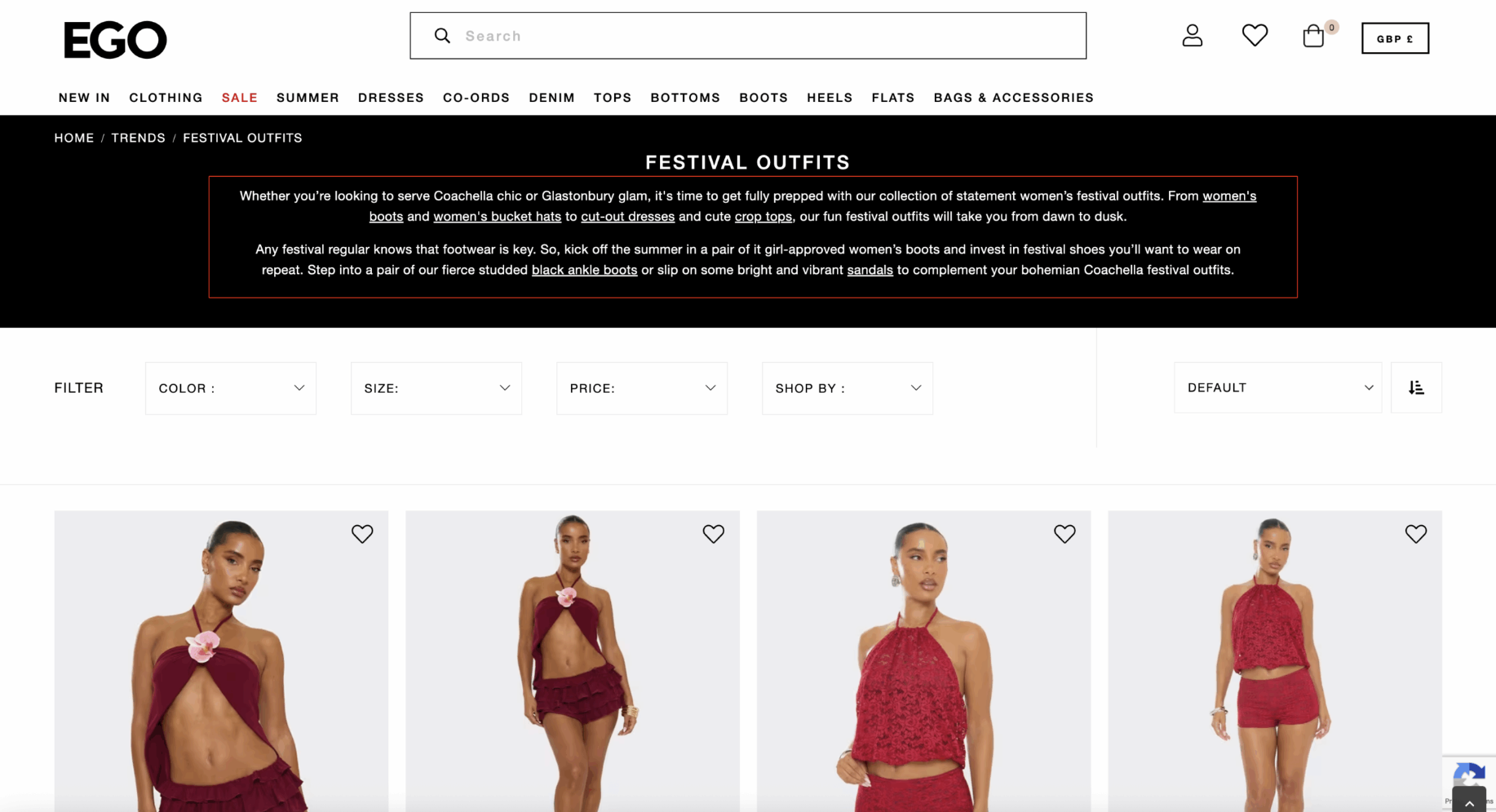
My goal for conducting this study was to showcase that you don’t need to add excessive amounts of content to a category page to rank in the top spots.
It wasn’t to show a correlation between word count and ranking. That’s not what I’ve looked at.
I wanted to showcase that useful content that gives context to the page matters more than word count, and that your focus should be on figuring out what is actually helpful vs what is just seen as filler or fluff. As well as showcasing that your category pages don’t need a ton of content added.
What 300 top-ranked eCommerce category pages tell us about how much content is really needed
The average eCommerce category page that ranks in position 1 on Google contains 310 words.
That’s often split between an intro above the product grid and an FAQ section below (where relevant).
But here’s the thing…
The content on category pages needs to be useful and help your potential customers find the product(s) they’re looking for. Often, that means not much text is needed at all. But sometimes, especially with more complex purchases, there’s a genuine need for more.
That said, the research shows that most top-ranked eCommerce category pages have no more than 200 words of content, with 44% of the pages analysed having a word count of 1-200.
In fact, a total of 66% of top-ranked category pages have less than 400 words on the page.
Interestingly, 10% of the analysed results had no content at all, aside from an H1 heading on the page. You can rank at the top of the SERPs without any content, but it’s definitely not recommended. But neither is putting in place too much content.
Of the 29 category pages with 0 words of content on the page except the H1 and product grid, 18 of these are what I’d consider mega brands…household names. The authority of these brands, alongside user signals for people who know the brand (brand + category searches), likely explains why they’re ranking so well without any text on the page.
This is significant. If you’re not a household name brand, don’t try to rank category pages without any content on them … however much your designer tries to persuade you!
I also don’t think it’s a coincidence that only 13% of the URLs analysed have more than 600 words of content on the page, and only 6% have more than a thousand.
It’s the relevance of the content to the query, and its usefulness to the user, that’s more important than word count.
In most cases, your potential customer doesn’t want to browse a full buying guide on the category page. If they want to read a buying guide, they’ll either search for it or click on it on your site.
This content doesn’t (usually) belong on the category page.
Create category page content that helps your customers to shop
Based on my analysis of these 300 top-ranked category pages, here’s what this means:
1. eCommerce category pages should include text content, but it should be a descriptive summary of the products being sold.
2. Rather than writing a few hundred words of generic content about the product category, use it as a space to shout about why a customer should buy from you, what they need to know about your range and the things they need to consider when finding the right product. Think of this as information gain for these pages.
3. If your category page content could be lifted pretty much word-for-word and placed on your competitors’ site, it’s too generic. This sounds simple, but it’s a good indicator of how valuable your content is on your own site.
4. Most eCommerce stores should expect to have no more than 400 words of content on category pages, with less than 200 words being more likely for most sites. The average number of words on the pages analysed was 310, but the most common word count grouping of these pages was 1 – 200.
5. Create category page content that helps your customers to shop and to buy from you first and foremost. Nobody wants to read a section on “what is [X]” on these pages. If they’ve found the page, there’s a pretty good (almost definite) chance they already know what the product is.
6. Don’t fall into the trap of publishing ‘buying guides’ below product grids. This is very rarely what a customer wants to see. Instead, focus on a value-packed intro above the product grid, with FAQs below it, as needed (avoid generic FAQs like ‘what is…’; tailor them to your own USPs).
This study shows that you don’t need to drown your eCommerce category pages in copy to rank.
Across 300 top-ranking UK category pages, the average word count was just 310 words, and two-thirds had fewer than 400.
The clear message?
It’s not about hitting an arbitrary word count. It’s about writing useful, relevant content that helps a shopper quickly understand your range, why they should buy from you, and how to make the right choice.
If you’re a household name, you might get away with minimal (or even zero) text.
If you’re not, you’ll need enough unique, helpful content to provide context and support your SEO goals, but never so much that it pushes the products or the intent out of focus.
Struggling with eCommerce content?
Digitaloft is a specialist content agency with over a decade of experience supporting brands with targeted organic growth strategies. Speak to our team of experts for tailored insights on how we could help your business win by owning the search moments that matter to you.