
Last updated: 5th Jul 2026
71 digital PR & link-building statistics for 2026.
 By Ellie Wraith, Head of Search
Get weekly SEO insights straight to your inbox.
Sign up to outranked, our weekly SEO newsletter
Digital PR and link-building remain two of the most effective ways to build off-page authority, improve search visibility, and drive long-term organic growth.
But the state of play is changing.
If you have any day-to-day involvement in digital PR, you’ll know that journalists are receiving more pitches than ever, search is becoming more competitive, and the discovery channels that use backlinks as a ranking factor are becoming more fragmented.
To help you benchmark your strategy, we’ve pulled together the most important digital PR and link-building statistics for 2026. We’re talking campaign performance, journalist preferences, AI adoption, cost-per-link data, and more. These insights show what is shaping the industry right now, and what tactics might deliver the best results for your brand.
The digital PR market in numbers
Digital PR agencies have become a core part of how brands establish visibility, authority, and long-term search performance, especially as organic competition increases and AI continues to reshape the way people discover content.
The following statistics highlight just how quickly the digital PR market is growing, and why stronger campaigns, better data, and sharper storytelling are becoming more important than ever.
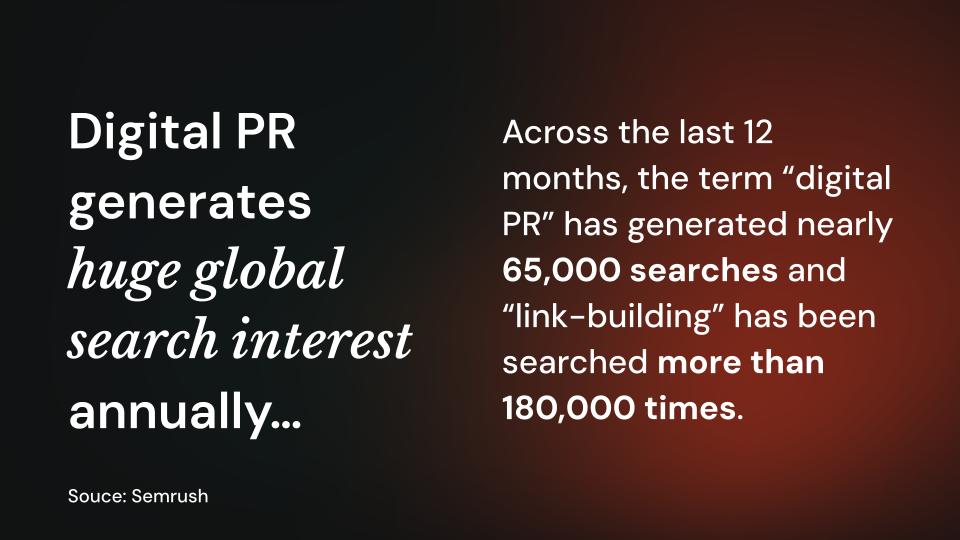
1. The term “digital PR” generated nearly 65,000 searches worldwide over the last 12 months
According to Google Search data, 64,800 users searched for “digital PR” between July 2025 and June 2026. That’s 5,400 searches every month for a single query.
And interest in digital PR as a discipline continues to grow. UK search demand has increased by 20% over the past two years, showing that digital PR is in no way viewed as a niche tactic. It’s recognised as a central part of how growth-focused brands build visibility, authority, and search performance.
That growing demand also points to a more competitive landscape. As more brands invest in digital PR, standing out is becoming harder. Stronger stories, better data, and sharper targeting are now essential if campaigns are going to cut through.
2. Searches for “link-building tactics” have increased by 151% globally since June 2024
Interest in “link-building tactics” has risen sharply over the past year, rising by over 150% worldwide. In the UK, demand has grown even faster, increasing by 330% over the last two years.
That tells us two things. First, brands still see backlinks as one of the strongest ways to improve visibility, rankings, and authority. Second, more marketers are chasing the same opportunities.
The result is a far more competitive environment. Generic outreach, mass-produced content, and low-value guest posts are becoming less effective. If brands want to earn links consistently, they need stronger campaigns, better prospecting, and genuinely useful content.
3. ‘Link-building’ has been searched more than 360,000 times worldwide since June 2024
Despite years of debate over algorithm changes and ranking signals, interest in link building remains high.
More than 360,000 searches worldwide show that marketers still see backlinks as one of the strongest indicators of authority and SEO performance, and that’s unlikely to change any time soon.
What is changing is the type of links that matter. Relevance, trust, topical fit, and editorial quality are becoming more important than volume alone.
Learn more about relevance in digital PR from Digitaloft’s founder, James Brockbank.
4. The global PR industry is growing by 6.5% annually and is expected to reach over $144 billion by 2028
PR continues to grow, and digital PR is a major reason why.
As audiences spend more time online and brands compete harder for attention, businesses are investing more heavily in media relations, content, and brand visibility.
That growth is good news for agencies and in-house teams, but it also raises the bar. More investment means more competition, and more competition means better work is needed to get noticed.
For brands looking to make waves, they need serious partners on their team. Good is no longer good enough. Now, great work should be the baseline expectation if you want to earn high-impact links that grow organic visibility and contribute to commercial growth.
5. The UK digital marketing industry reached $21.3 billion in 2025
The UK digital marketing industry is continuing to grow with pace. Valued at $21.3 billion in 2025, the market is expected to more than double to $47.4 billion by 2034.
That level of growth reflects a wider shift in how brands are investing their budgets. Ecommerce continues to expand, smartphone usage keeps rising, and social platforms are becoming more influential in how people discover brands and content.
It also points to a more competitive future. As more businesses invest in digital channels, standing out will become harder. Brands that rely on the same tactics as everyone else will struggle to get noticed.
For businesses, that means building campaigns that do more than generate visibility. They need to earn attention, strengthen brand authority, and support performance across search, social, and wider digital channels.
Why businesses invest in digital PR
Smart businesses don’t invest in digital PR just to earn links. They invest because they want more traffic, stronger rankings, greater authority, and ultimately more revenue.
These statistics explore why and how businesses choose to invest in digital PR as a link-building tactic.
6. 48.6% of businesses rate digital PR as the most effective link-building tactic
There are plenty of ways to build links, but digital PR continues to outperform them all.
That’s because it focuses on earning links naturally through newsworthy stories, original data, expert commentary, and creative campaigns.
The strongest links are not bought or traded. They are earned because the story is genuinely worth covering.
7. Less than half (48%) of organisations invest in link-building to increase sales and revenue
Many businesses still think about link-building through an SEO lens rather than a commercial one.
They invest to improve rankings, increase visibility, and grow traffic, but fewer directly connect links with revenue.
That creates a disconnect, because strong link building should not just improve rankings. It should also support lead generation, increase branded search demand, and contribute to long-term business growth.
8. The most common reasons organisations invest in link-building are to increase organic traffic and improve rankings
Most businesses still see link-building as a way to improve search performance.
And they are not wrong. High-quality backlinks remain one of the strongest indicators of authority, trust, and relevance.
But businesses that stop there risk underselling the wider value of digital PR. The strongest campaigns do not just improve rankings. They also increase awareness, strengthen brand credibility, and create more demand further down the funnel.
9. 85% of SEO experts believe link-building has a big impact on brand authority
We’ve said digital PR isn’t just about earning links…but these links aren’t just about rankings!
Every time a trusted website references or links to a brand, it strengthens credibility by providing what SEOs call PageRank. Over time, the cumulative effect of this can significantly affect how a business is perceived by customers, journalists, and search engines alike.
That’s especially important in competitive sectors, where trust is often a key factor in purchase decisions.
10. High-ranking results have more referring domains than low-ranking results
The relationship between links and rankings is still incredibly strong.
Pages that rank highly in search tend to have more referring domains pointing to them than pages lower down the results.
That does not mean having more links always equals better performance. Relevance, authority, and topical fit all matter too. But it does reinforce the fact that brands cannot ignore backlinks if they want to compete organically.
The biggest digital PR and link-building challenges facing businesses
We know that links matter…but this is only part of the battle.
Whether it’s an in-house digital PR professional, an SEO specialist, or an outsourced digital PR team, the common denominator is overcoming challenges when building links.
These challenges span everything from strategy and reporting to brand-agency relationships and proving ROI to stakeholders, but knowing how to get around them is the key to winning and standing still.
11. 70% of businesses are not fully satisfied with their current link-building agency or freelancer
There is a growing disconnect between what businesses expect from link-building and what they actually get.
For many brands, the frustration stems from poor communication, weak reporting, or a lack of commercially meaningful results. Links might be increasing, but if rankings, traffic, and revenue are not moving with them, confidence quickly starts to drop.
Businesses are becoming more selective. They want better-quality links, a clearer strategy, stronger reporting, and a clearer connection between digital PR activity and business growth.
For the team at Digitaloft, this stat is only a motivator to deliver great, not good work. We don’t settle for average, and we don’t believe our clients should either. Check out some examples of the success we drive by reading our case studies.
12. 40% of digital PR professionals struggle to showcase the value of what they do to senior stakeholders
Four in ten digital PR teams still struggle to communicate their value in a way that resonates with senior stakeholders.
That’s often because reporting is too focused on outputs rather than outcomes. Senior leaders do not just want to know how many links were earned or how many pieces of coverage landed. They want to understand what that activity is doing for rankings, traffic, lead generation, and revenue.
This lack of awareness is where many teams fall short.
If digital PR is going to be seen as a growth channel rather than a brand exercise, reporting needs to become much more commercially focused.
Amy Gibson, Strategy Director at Digitaloft, says:
“Showcasing the value of digital PR is something that our industry really struggles with, but this is because they often try to show the value after they have executed the strategy.
Being able to showcase the value to the C-suite starts from day zero. Every senior stakeholder has metrics that matter to them specifically, but 99.9% of C-suite executives care about how digital PR activity impacts commercial traffic, lead generation, and revenue.
To showcase the bottom-line impact of your digital PR activity, your strategy needs to align with the wider SEO strategy. You need to be earning links to the target commercial pages, as well as internally linking to them from any onsite campaign pages. Then, when it comes to your reporting, you can silo out the impact on those pages.
Finally, if your digital PR agency is just reporting on links, DR, and whether something is follow or nofollow, then they are extremely outdated in their approach. Reporting should include metrics such as ranking changes for priority keywords, traffic from commercial pages, branded search, and organic revenue to demonstrate the value digital PR is having.”
Getting senior stakeholders to invest in SEO can be one of the hardest things for in-house teams. Read our top tips on how to win SEO buy-in from the C-suite to secure the budget you need.
Measuring the success of link-building
Businesses are getting better at measuring link-building performance, but there is still a long way to go.
Many continue to focus on rankings and traffic, while others are starting to look at revenue, AI visibility, and brand impact. The challenge is that not every business is measuring the same things, which makes it much harder to compare performance or understand what good looks like.
That’s why reporting matters. If businesses cannot clearly explain what their links are doing, it becomes much harder to prove value, secure budget, and get buy-in from senior stakeholders.
13. The most common metric used to evaluate the impact of links is increased organic visibility of target pages
Most businesses still judge the success of link building by whether their key pages are becoming more visible in search results.
That makes sense. If a page is moving up the rankings, attracting more impressions, and generating more organic traffic, it is usually a good sign that backlinks are helping.
But visibility alone only tells part of the story.
A page can rank better without driving meaningful commercial impact. Strong reporting should go beyond rankings and show whether increased visibility is driving more qualified traffic, better engagement, and stronger conversion performance.
14. Less than one-third (28%) of businesses say they look at increased revenue from organic visits from referral pages
Very few businesses currently connect links with revenue.
That’s surprising, especially given how often link-building is positioned as a growth tactic. If the goal is to increase visibility, attract better traffic, and support commercial growth, then revenue should be part of the conversation.
The businesses doing this well are usually the ones that connect SEO, analytics, and CRM data. They can see which links are influencing traffic, which pages are converting, and which campaigns are driving the strongest return.
That gives them a much clearer picture of value than rankings or traffic alone ever could.
15. Only half (53%) of businesses think their link-building reports are easy to understand
Reporting often becomes too technical, too vague, or too focused on vanity metrics.
Senior stakeholders do not want to read complicated spreadsheets full of referring domains, anchor text distributions, and DR scores. They want to know what has changed, why it matters, and what impact it is having on the business.
That’s where many reports still fall short.
The best reporting is simple, commercially focused, and easy to digest. It should explain what links have been earned, how visibility has changed, and whether that activity is influencing traffic, leads, or revenue.
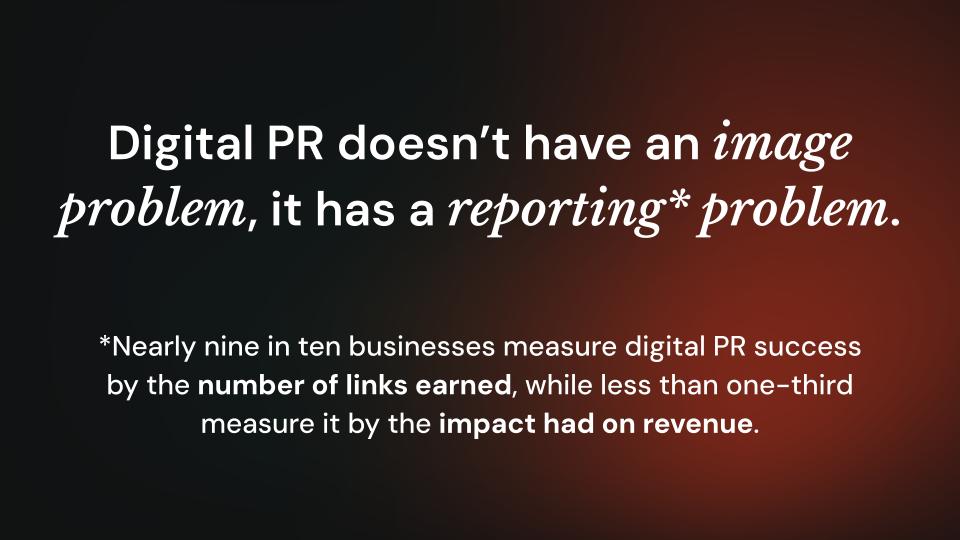
16. 85.1% of businesses measure the success of a digital PR campaign by the number of quality links, versus 28.4% who measure success by an increase in leads or conversions
Most businesses still judge digital PR primarily on links, but is this right in today’s landscape?
On the one hand, it’s understandable because links are easy to measure and easy to compare across campaigns. They are also one of the clearest signs that a campaign has landed successfully with journalists and publishers.
But links should be a means to an end, not the end goal itself.
The strongest campaigns do more than build backlinks. They increase branded search demand, improve rankings, drive referral traffic, support lead generation, and influence conversions further down the funnel.
Businesses that only focus on link numbers risk missing the bigger picture.
The most effective link-building tactics
There is no single way to build links.
In fact, the strongest digital PR campaigns tend to combine several tactics together depending on the industry, audience, and objective. Some tactics are better suited to generating quick wins, while others are more effective for building long-term authority.
What matters is finding the right mix of cards and knowing when to play them for the greatest effect.
17. 95.3% of businesses cite data-led content and providing expert commentary as the primary link-building tactics
Original data and expert insight remain the backbone of most successful digital PR campaigns.
That’s because journalists want stories that give them something new to say. Surveys, industry reports, trend analysis, and reactive commentary all make it easier to create content marketing campaigns that are timely, relevant, and worth covering.
Brands that can offer exclusive insights or credible expertise are far more likely to stand out in crowded inboxes.
And as more businesses invest in digital PR, that type of originality is becoming even more important. Generic campaigns and recycled ideas are much harder to land links from than they were a few years ago.
Chloe Meadows, Digitaloft’s Associate Digital PR Director, says:
“In an environment increasingly saturated with misinformation and AI-generated experts, real expert commentary has become a key tactic in digital PR.
When done well, expert commentary can add genuine value to a story by introducing a new perspective and helping content to stand out from the crowd.
However, with the rise of AI generated experts, journalists are more cautious. There is a clear shift towards more rigorous calibration of sources. PR professionals must ensure that any expert used is both credible and easily able to be verified.
To help, we need to include links directly to their robust author page on-site. At a minimum, this should include background information (for example, education is especially important in YMYL sectors – law, finance, and health), a professional image, links to social platforms such as LinkedIn, and examples of previous media coverage.
Some journalists are now requesting direct verification, including phone calls, so it’s important to confirm in advance whether your expert is comfortable being contacted in this way.”
18. 89% of SEO experts cite content and outreach as the preferred link-building strategy
The best campaigns combine both great content and targeted outreach into a coherent, well-aligned strategy.
They start with a strong idea, a clear story, or a useful asset, then pair it with smart targeting and expertly crafted outreach engineered from the ground up to catch the attention of journalists positioned to cover it.
That balance matters because even the strongest campaign or most original dataset can fall short of meeting its potential if it is sent to the wrong journalists or pitched in the wrong way.
19. More than three-quarters (75.3%) of SEO professionals write guest posts to earn backlinks
According to surveys of SEO professionals, guest posting remains one of the most widely used link-building tactics.
Done well, it can help brands strengthen topical relevance, build authority, and reach new audiences through trusted publications.
But the quality bar is getting higher.
Low-value guest posts written purely to secure a backlink are becoming less effective, particularly as publishers become more selective and search engines continue to prioritise quality.
The strongest guest content offers genuine insight, unique expertise, or a perspective that readers will actually care about. It also shows true relevance between the publisher and guest poster – if the two don’t make sense together or speak logically to similar audiences, the entire arrangement falls apart.
20. Nearly one-third (32%) of marketers use newsjacking techniques to earn backlinks
Reactive PR can be one of the fastest ways to secure coverage.
When a major news story breaks, journalists often seek fresh data, useful context, or expert opinion to strengthen their reporting. Brands that can respond quickly have a much better chance of being included.
But speed alone is not enough.
The strongest reactive campaigns still need to be relevant, insightful, and closely aligned with the story itself. Chasing every trending topic under the sun is great in theory, but it rarely works – who has the time and resources, right? Picking the right moments for the brand, objectives, topic focuses, and audience is what does.
Millie White, Head of Digital PR at Digitaloft, says:
“Reactive PR can be one of the most effective elements of your strategy if executed well. Speed is arguably the most important factor, but no matter how quick you are to react to a breaking news story or a new trend, if it’s not relevant to the brand, then it’s essentially a waste of time.
Relevance has been a major topic of conversation within the industry in recent years, and it’s only become more vital to the strategies we create for our clients, and reactive PR is no exception. It’s really important to pick your moments and understand if your client or brand can actually add value to this conversation. If you feel any hesitation around the relevance of the topic, it’s likely not the right fit.
Alongside speed and relevance, it’s really key to find a gap in that story that a journalist can’t fill themselves. When a news story breaks, a journalist is already aware of what’s happening and has often already been briefed by their editor on what they need to cover. They aren’t looking for a PR to tell them what they already know, so it’s important to really cut the fluff and get to the point when pitching out reactive content!
A journalist is looking for a pitch to land in their inbox that gives them added value to the article they’re already writing, easily extractable and usable content or commentary, or useful data insights they can’t get hold of themselves.
Not only is reactive PR one of the quickest and most effective ways to secure coverage (when done right!), it’s actually one of the easiest ways to build strong journalist-PR relationships. And, if you’re adding value every time, you can even become that journalist’s go-to for exclusive commentary and industry insights.”
21. 58.4% of digital PR professionals reclaim unlinked brand mentions
Some of the easiest links to earn are the ones you have already partially won.
If a publication is already mentioning your brand, product, or spokesperson, asking them to add a link is often far easier than pitching a completely new story.
That’s why unlinked brand mention reclamation remains such an effective tactic, and we fold it into every digital PR strategy at Digitaloft.
It is quick, relatively low effort, and often delivers strong results, particularly for brands that are already generating coverage or brand awareness through other channels. Plus, including a link to the brand or study referenced adds value to the audience, elevates their experience as readers, and presents a win-win opportunity.
Link quality, link costs, and backlink benchmarks
Let’s cut to the chase: not all links carry the same weight.
One strong, relevant backlink from a trusted website can often outperform dozens of weaker placements, and that’s precisely why smart businesses are paying closer attention to quality, authority, and relevance rather than simply chasing volume.
At the same time, the cost of earning links is increasing, which makes efficiency more important than ever.
22. Gaining one high-quality backlink can perform better than 50+ low-quality links
Data shows that one strong link can have a disproportionately large impact on a site’s organic performance.
A backlink from a trusted national publication, respected trade website, or highly relevant industry blog can improve rankings, strengthen authority, and drive referral traffic all at once.
By comparison, dozens of low-quality links from irrelevant websites often add very little value.
That’s why digital PR campaigns that secure coverage on strong publications can often outperform more traditional volume-led link-building tactics that can lack a bigger-picture strategic base.
23. 87.2% of people evaluate the quality of a link by site relevance
Relevance is one of the biggest factors in whether a link is seen as valuable.
A backlink from a website in your industry is often much more useful than a link from a completely unrelated site with a higher authority score.
That’s because relevant links tend to send stronger trust signals. They make more sense to users, align more closely with the content they link to, and help search engines better understand what a brand is associated with.
24. 52% of SEOs require a minimum DR of 50+ for any link placement
Many SEO professionals now have stricter quality thresholds when deciding which opportunities are actually worth pursuing.
A minimum DR of 50 is often seen as a sign that a website has enough authority to pass meaningful value.
But authority metrics should never be looked at in isolation.
A lower-DR site with strong topical relevance and a highly engaged audience can still be much more valuable than a generic, higher-authority website with little connection to the brand or campaign.
25. The average Ahrefs Domain Rating of a piece of digital PR coverage is around 61
Digital PR tends to earn links from stronger websites than many other link-building tactics.
An average domain rating (DR) of 61 suggests that most coverage comes from publications with a relatively high level of authority.
That’s one of the reasons why digital PR remains so effective. It gives brands access to websites that are often difficult to secure links from through more traditional methods.
26. The average link earned with digital PR has a domain authority (DA) of 43, a domain rating (DR) of 41, and a trust flow (TF) of 30
Not every valuable link comes from a huge national publication. Quite the opposite, in fact.
These averages of industry-recognised metrics show that many digital PR links come from mid-tier websites with a reasonable level of authority and trust.
That’s important because strong link profiles are usually built through a mix of different websites rather than relying entirely on top-tier coverage.
27. Just 20% of links come from domains with a DA of 70 and above
The highest-authority links are still relatively rare and are almost always earned through specialist, targeted digital PR outreach.
That’s why campaigns should not be judged solely on whether they secure coverage on the biggest sites. Strong links from niche industry publications, local media, and specialist websites can still have a significant impact.
In many cases, those more relevant links can be just as valuable as coverage on a major national title.
28. 48% of backlinks are follow, 19% are nofollow, and 33% are syndicated
Digital PR campaigns generate a mix of link types, and each can contribute value in different ways.
Follow links are important for passing authority, but nofollow links still matter too. Since 2019, Google has treated nofollow as a hint rather than a directive, meaning these links can still be crawled, used for discovery, and potentially contribute to how search engines understand a brand’s authority and relevance.
Syndicated links have value as well. They can amplify reach, increase exposure across multiple sites, and help campaigns gain more traction beyond the original piece of coverage.
We asked Digitaloft’s Strategy Director, Amy, to comment on misconceptions about the value of nofollow links:
“The opinion that nofollow links have no value is very outdated. Since 2019, Google has treated nofollow as a hint rather than a directive, and we know from the Google leak documentation that a nofollow link on a high-quality and high-traffic publication (e.g., a large national title or respected industry publication) would be classed in the ‘high-quality’ tier, meaning it would provide SEO value by passing PageRank.
If you only about links that are “follow”, you are missing out on a massive opportunity. You shouldn’t get caught up on if a link is “follow” or “nofollow”, but focus on where those links are coming from (e.g., are they on a site your target audience is reading) and the story they are telling (e.g., is it relevant and on brand).”
29. 82% of links earned with digital PR are followed
This is one of the reasons digital PR remains such a valuable SEO tactic.
The majority of links earned through campaigns are follow links, which directly contribute to rankings and authority.
That makes digital PR particularly attractive for brands looking to combine awareness-building with measurable SEO impact.
30. 4 in 10 (39.2%) of businesses do not know their average cost per link
Many businesses still struggle to understand the true cost of link-building.
Without that visibility, it becomes much harder to benchmark performance, compare campaigns, or understand whether spend is translating into value.
The businesses that track cost per link more effectively are usually in a much stronger position to improve efficiency over time.
But…and this is a big but…cost-per-link can be a dangerous metric to obsess over. Sure, we all like getting a good deal, but it’s the impact of those links on the business’s bottom line that we should really care about – ROI over upfront cost is what matters.
31. Three-quarters (74.3%) of businesses spend over $5,000 per month on digital PR contracts
Businesses are investing serious money into digital PR.
That level of spend reflects the growing importance of links, brand visibility, and authority in competitive search markets.
It also reinforces why expectations around reporting and ROI are becoming more demanding. When budgets are high, stakeholders want clear evidence that campaigns are delivering value.
32. 81.1% of businesses say they never pay for links
The numbers don’t lie – the vast majority of businesses reject the idea of buying links outright, saying they’d never consider it as a tactic.
That’s because earned links are generally seen as more credible, more sustainable, and less risky in the long term.
As search engines continue to crack down on manipulative tactics, the appeal of high-quality earned coverage is only likely to grow.
Statistics on digital PR tools and technologies
New tech is being released all the time, meaning the baseline toolkit digital PRs rely on continues to evolve.
Teams are now using a mix of SEO platforms, media databases, outreach tools, and AI software to improve efficiency and uncover better opportunities. But while the tools are changing, the fundamentals remain the same.
Great campaigns still rely on strong ideas, relevant outreach, and clear reporting.
33. 59.1% of digital PRs choose Ahrefs as the top all-in-one tool
Ahrefs remains the go-to platform for many SEO and digital PR professionals.
That’s largely because it brings several important functions together in one place. Teams can use it to analyse backlink profiles, monitor competitors, identify outreach opportunities, and understand which pages are attracting the most links.
For businesses investing heavily in link-building, visibility matters. The clearer you can see what competitors are doing, the easier it is to identify gaps and opportunities.
34. Google Search Console, Semrush, and Ahrefs are the most widely used tools for link-building
Most link-building teams rely on a familiar mix of tools.
Google Search Console helps businesses understand which pages are gaining visibility and attracting clicks. Semrush and Ahrefs make it easier to assess backlinks, benchmark competitors, and spot opportunities for new content or outreach.
Together, these tools give digital PR teams a much clearer picture of where authority is being built and where more work is needed.
35. Muck Rack, BuzzStream, and Roxhill are the most widely used platforms for building media lists
As the saying goes, it’s not what you know, but who you know. And in digital PR, outreach is only as strong as the list of contacts behind it.
Media databases and outreach platforms help digital PR teams identify the right journalists, understand what they cover, and keep track of conversations over time.
That’s becoming increasingly important as inboxes get more crowded. Better targeting usually leads to better response rates, more relevant coverage, and less wasted effort.
36. 73.6% of digital PRs use AI to help with ideation for campaigns
Like it or not, AI is becoming a much bigger part of just about every marketing process, digital PR campaign ideation included.
Many teams now use it to generate ideas, spot patterns in search demand, analyse trends, and speed up early-stage research. That can save a huge amount of time, particularly when teams are under pressure to produce ideas quickly.
But AI is still only part of the process.
The strongest campaigns are usually those in which AI supports human thinking rather than replacing it. Originality, timing, and a clear understanding of what journalists actually want are still what set average campaigns apart from those that earn standout coverage.
Agency relationships, reporting, and expectations
As businesses invest more in link-building, expectations are rising.
Brands want stronger links, better reporting, clearer communication, and more confidence that their investment is driving meaningful results. That’s putting more pressure on agencies and freelancers to prove value.
37. 40% of businesses use agencies or freelancers to support digital PR
Many businesses still rely on external support for digital PR and link building.
That’s often because they lack the in-house resources, media contacts, or specialist expertise needed to run campaigns consistently. For smaller teams in particular, outsourcing can be the fastest way to access skills they would struggle to build internally.
But handing work to an agency is not a guarantee of results.
The strongest relationships tend to happen when both sides are aligned on goals, timelines, and what success actually looks like.
38. 62% of businesses want to improve their overall backlink strategy
Most businesses know they could do more with link building.
Some are unsure which tactics are worth investing in. Others struggle to identify the right opportunities, create content worth linking to, or understand where they are falling behind competitors.
That’s why strategy matters so much.
Without a clear approach, it’s easy to chase links for the sake of it rather than focusing on the opportunities most likely to influence rankings, visibility, and revenue.
39. Two-thirds of businesses feel they could do better at selecting the best backlink tactics
There is no shortage of link-building tactics available.
Guest posting, reactive PR, data-led campaigns, expert commentary, link reclamation, digital assets, tools, and resource pages can all work well. The problem is that not every tactic is right for every brand.
Businesses that try to do everything often end up spreading themselves too thin.
The strongest strategies are usually much more focused. They prioritise the tactics that make the most sense for the industry, audience, and goals.
40. 63% of businesses want to get better at reporting on the impact, outcomes, and ROI of link-building
Reporting is still one of the biggest weaknesses in link-building.
Most businesses can tell you how many links they have earned. Far fewer can explain what those links are actually doing for rankings, traffic, leads, or revenue.
That becomes a problem when budgets are under pressure.
If businesses cannot clearly demonstrate value, it becomes much harder to justify future investment or secure buy-in from leadership teams.
41. More than two-thirds (68%) of businesses do not have a fully documented approach for link-building
A surprising number of businesses are still approaching link-building without a clear framework.
That often leads to inconsistent activity, unclear priorities, and campaigns that are difficult to scale.
A documented strategy does not need to be overly complicated. But businesses that know which pages they are prioritising, which tactics they are using, and how they will measure success tend to perform much more consistently over time.
42. One-third of leadership teams want quick wins from link-building
There is often a mismatch between what leadership teams want and how link-building actually works.
Many senior stakeholders expect quick results, particularly when budgets are high. The reality is that strong digital PR campaigns take time to plan, pitch, secure coverage, and influence rankings.
That does not mean quick wins are impossible. But they are rarely the full picture.
The brands that get the best results are usually the ones prepared to invest consistently rather than expecting immediate returns.
43. 60% of leadership teams want to see the results of digital PR within six months
Six months can be enough time to generate links, improve rankings, and increase visibility.
But some of the biggest gains from digital PR take much longer to appear.
Brand awareness, authority, and organic growth tend to build over time rather than overnight.
That’s why expectation-setting matters so much.
If businesses judge campaigns solely by what happens in the first few months, they risk missing the longer-term value that strong digital PR can deliver.
Campaign performance and digital PR outcomes
The strongest digital PR campaigns do much more than earn a handful of links.
They can improve rankings, strengthen brand awareness, increase referral traffic, and generate conversations across social media, too. That’s why businesses are looking more closely at the wider impact of campaigns rather than judging success solely by links.
44. 80.4% of businesses cite digital PR as an effective way to build brand awareness
Digital PR is often viewed through an SEO lens, but its impact extends far beyond rankings.
Strong campaigns can put brands in front of new audiences, increase familiarity, and help businesses become more recognisable within their industry. That’s particularly valuable in competitive markets where awareness is often the first hurdle.
The more consistently a brand appears across trusted publications, the easier it becomes to build credibility and stay front of mind.
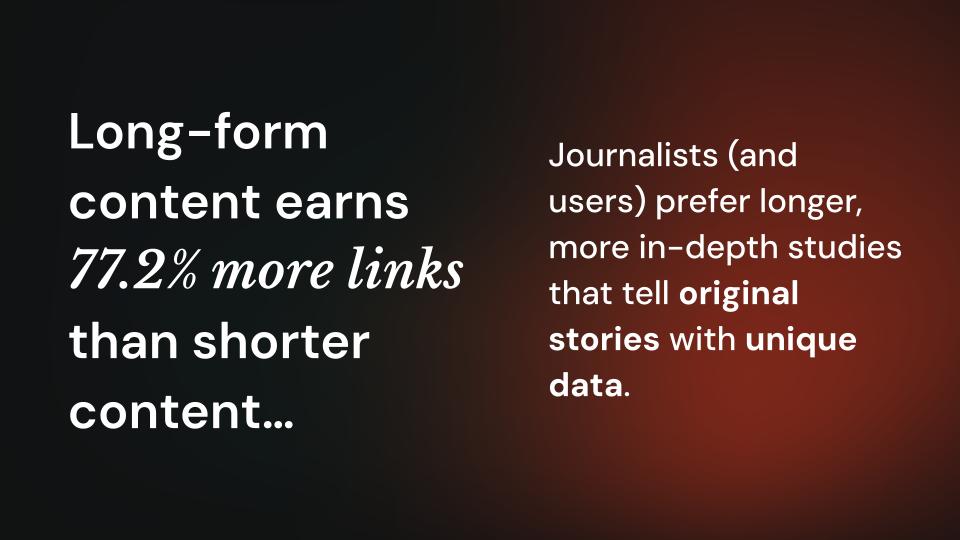
45. Long-form content gets 77.2% more links than shorter content
Longer content tends to perform better because it gives people more reasons to reference it.
Detailed guides, original research, tools, and in-depth resources are naturally more linkable than short opinion pieces or surface-level blog posts.
They usually cover a topic in more depth, answer more questions, and provide more value to readers.
Now, that doesn’t mean every page should be as long as practically possible.
More doesn’t always mean more.
But when businesses are investing in content to support digital PR, it is usually worth creating something substantial enough to stand out.
46. 55.2% consider link-building the most challenging part of SEO
Many businesses still see link-building as the hardest part of SEO.
Technical fixes and on-page improvements are often easier to control. Link-building is different because it relies on creating something people genuinely want to talk about, then getting it in front of the right audience.
That’s what makes it difficult, but it is also why it can be so valuable.
Strong links are much harder to replicate or implement at scale than title tags or content tweaks, which is why they can create a much bigger competitive advantage.
47. The average digital PR campaign earns links from 42 unique referring domains
A strong digital PR campaign can still generate meaningful authority and SEO value.
Earning links from more than 40 different websites can help improve rankings, strengthen trust signals, and increase referral traffic all at the same time.
But the strongest campaigns are not always the ones with the most links. A smaller number of highly relevant placements can often have a much bigger impact than a long list of weaker sites.
48. An average campaign gains 1,000 social engagements
Strong campaigns do more than earn links. They create conversations and shape audience behaviours via an average of 1,000 social interactions.
Shares, comments, and wider engagement across social media channels can help campaigns travel further, reach more journalists, and generate additional coverage long after the original launch.
That kind of amplification is often overlooked, but it can play a big role in increasing brand awareness and creating secondary opportunities for links and mentions.
Journalist behaviour and outreach statistics
We’ve all been there. We have a rock-solid, hard-hitting, data-rich campaign in our back pocket, but it falls short of success at the final hurdle – outreach.
Part of the solution is facing up to the reality of the situation, though. Journalists are receiving more pitches than ever before, which means relevance, timing, and personalisation matter far more than they used to.
Generic mass emails are easy to ignore, while strong relationships, useful stories, and carefully targeted outreach are much harder to overlook.
49. Nearly half (48%) of digital PR professionals always send personalised email pitches to journalists
It’s official: mass outreach is becoming less effective.
In today’s saturated landscape, the strongest pitches feel tailored, relevant, and closely aligned with what the journalist actually covers.
That does not necessarily mean rewriting every email from scratch, but it does mean showing a clear understanding of the publication, the audience, and why the story matters.
Personalisation takes more time, but it tends to produce much stronger results than sending the same pitch to hundreds of contacts.
50. 20% of digital PR professionals think having an existing relationship with a journalist is the most important factor in securing coverage
Relationships still matter. If anything, they matter more now than ever before.
Experience shows that journalists are far more likely to open, read, and respond to someone they recognise and trust. That’s particularly true when they are working to tight deadlines and need reliable sources quickly.
Building strong relationships takes time, but it can make outreach much more effective over the long term. Brands that invest in relationships often find it easier to secure repeat coverage and more meaningful media opportunities.
51. 89% of digital PR professionals cite direct email as the most effective pitching channel, followed by Twitter/X and mass email
Despite the growth of social media and messaging apps, email remains the preferred way to pitch journalists.
That’s where most reporters expect to receive stories, commentary, and follow-ups. It is also where they have the most control over what they read and how they respond.
Other channels can still be useful, particularly for building relationships, but email continues to outperform everything else by a considerable margin.
52. 92% of digital PR professionals prefer to keep their pitches under 300 words
Journalists do not want long, complicated emails. But who can blame them, really…would you?
The strongest pitches are short, clear, and easy to understand. They explain the story quickly, make the angle obvious, and give the journalist everything they need without overwhelming them with unnecessary detail.
If the value of a story is not immediately clear, there is a good chance the email will be ignored. So cut the crap.
53. Over half (54%) send follow-ups to journalists 3–6 days after the initial send
Following up is still an important part of the outreach process.
A well-timed follow-up can often be enough to bring a story back to the top of a journalist’s inbox and improve the chances of getting a response.
The key is timing. Follow up too quickly, and it can feel pushy. Leave it too long, and the opportunity may already have passed.
54. 81% prefer to send pitches before midday
Timing can make a noticeable difference to open rates and responses.
Many digital PR professionals prefer to send pitches in the morning, when journalists are planning their day and reviewing potential stories.
That does not guarantee success, but it can improve the chances that an email will be seen before inboxes become more crowded later in the day.
55. The biggest challenge faced by digital PR professionals is getting responses from journalists
Journalists are dealing with crowded inboxes, tighter deadlines, and more irrelevant outreach than ever before. That means even good stories can struggle to get attention if they are not positioned in the right way.
For digital PR teams, that puts even more emphasis on targeting, timing, and finding angles that feel genuinely useful or interesting.
56. Only one in three pitch emails gets opened by journalists
It’s a harsh reality to face, but most outreach never even gets read.
That’s why subject lines and personalisation matter so much. If an email does not stand out immediately or clearly signal why the story is relevant, there is a good chance it will be ignored.
Small improvements to subject lines, targeting, and timing can often have a much bigger impact than people expect.
57. 73% of journalists reject pitches as irrelevant, and 49% rarely or never respond to cold pitches
Generic outreach remains one of the biggest problems in digital PR.
Too many journalists are still receiving stories that are not relevant to their beat, audience, or publication. That leads to frustration on both sides.
Brands that invest more time into targeting and tailoring their outreach are usually the ones that get better results.
58. Three-quarters of journalists are more likely to respond to pitches that include original data or research
Original research, exclusive findings, surveys, and expert insight all make it much easier for a journalist to build a story. Without that, most pitches end up feeling interchangeable.
That’s one of the reasons why data-led campaigns continue to perform so well. They give journalists something unique, timely, and useful to work with.
59. The majority (87%) of journalists prefer to receive pitches via email
Despite the growth of social platforms and messaging tools, email remains the preferred outreach channel by a distance.
That’s where most journalists expect to receive stories, commentary, and follow-ups. It is also where they are most likely to track pitches relevant to future features.
For digital PR teams, that means the basics still matter. Clear subject lines, concise copy, and relevant stories will almost always outperform more complicated approaches.
60. Three-quarters (77%) of journalists would block a PR for sending multiple irrelevant pitches
Poor outreach does not just get ignored. It can damage relationships, too.
Repeatedly sending irrelevant pitches can quickly reduce trust and make it much harder to secure coverage in the future.
That’s why quality matters more than quantity. Sending fewer, better-targeted emails is much more effective than sending large volumes of irrelevant outreach.
Industry trends and sector-specific challenges
Some industries are naturally easier to earn links in than others.
Certain sectors lend themselves to data-led stories, seasonal trends, and broad consumer interest. Others face stricter regulations, more competition, or greater scrutiny from journalists and publishers.
That’s why the same approach rarely works everywhere…and why the team here at Digitaloft crafts wholly bespoke strategies with tailored, industry-specific media lists for every client.
Want to hear more? Get in touch with our experts to find out what this could look like for your business.
61. Finance, health and wellness, education, and fashion and beauty are seen as the hardest industries for link-building
Some sectors are much more difficult to earn links in than others.
Finance and health are heavily regulated, which can make it harder to create stories that feel both newsworthy and compliant. Education is highly competitive, while fashion and beauty brands often struggle to gain attention in an overcrowded media landscape.
These sectors also tend to have higher expectations around credibility and expertise. Journalists are less likely to cover weak stories or generic commentary when dozens of similar brands are already saying the same thing.
That means businesses in these industries often need stronger creative ideas, better data, and more specialist expertise to stand out.
62. Real estate and travel are seen as the easiest industries for link-building
The seasonal hooks, strong visuals, location-based angles, and broad consumer appeal mean travel and property naturally lend themselves to coverage. That gives brands in these sectors more opportunities to create stories that journalists actually want to cover.
Travel campaigns can tap into trends around holidays, cost of living, or destination popularity, while property brands can use house prices, rental data, or regional insights to create stories with wide appeal.
That does not mean links come easily, but it does mean there are often more natural opportunities to generate coverage.
63. Around half (50.9%) of digital PR professionals say they work most closely with SEO teams
Digital PR and SEO are two sides of the same coin – SEO as the overarching strategy, and digital PR as one of the core tactics that enable success.
When teams collaborate more closely, it becomes easier to identify which pages need links, which stories are most likely to support rankings, and where campaigns can drive the biggest commercial impact.
Interestingly, studies suggest that only half of digital PR professionals are actively leveraging SEO teams’ expertise to boost performance, likely leaving high-value opportunities to drive organic growth on the table.
64. 94% of published web pages have zero backlinks
It’s not the most motivating of statistics at face value, but most content never earns a single link.
That’s because much of it offers nothing original, useful, or interesting enough to stand out. Generic blog posts and recycled ideas are easy to ignore.
For brands, this reinforces the importance of quality. If content is not genuinely useful or newsworthy, it is unlikely to attract links, no matter how much outreach sits behind it.
SEO priorities and attitudes towards link-building
For years, the focus of link-building was largely on volume – more links, more domains, more activity. Now, the conversation is becoming much more nuanced.
Businesses and the PR professionals they engage are thinking more carefully about where links point, what type of authority they build, and how they support wider commercial goals beyond superficial KPIs.
65. 52.7% consider service and product pages the most important for link acquisition
Businesses are becoming more commercially focused in the way they approach link-building.
Rather than prioritising links to blog posts or top-of-funnel content, many are focusing their efforts on service and product pages because those are the pages most closely tied to leads, sales, and revenue.
That creates a challenge, though.
Commercial pages can be among the hardest to earn links naturally.
Fewer journalists want to link directly to a service page, and most publishers are much more likely to reference useful research, tools, or broader informational content.
That’s why many businesses use digital PR to build authority elsewhere on the site, then rely on internal linking to pass value through to the pages that matter most.
66. 78.8% think that nofollow links impact rankings
We touched on this earlier when breaking down the split between follow and nofollow links, but it’s worth drilling into deeper. Nearly eight in ten PRs think nofollow links are no longer seen as second-class.
Most professionals now recognise that even if a link is marked as nofollow, it can still contribute value. Google has treated nofollow as a hint rather than a strict directive for several years, which means those links can still support crawling, discovery, and broader authority signals.
That matters because many of the publications brands most want coverage from automatically apply nofollow tags to outbound links.
If a business only focuses on follow links, it risks overlooking opportunities on some of the biggest and most trusted sites on the web.
67. 93.8% of link builders say link quality matters more than quantity
There was a time when link-building was treated like a numbers game. The more links a website had, the better. But that way of thinking has become outdated.
Most digital PR professionals now care far more about the relevance, authority, and trustworthiness of a link than the volume of links a campaign earns overall. One strong placement on a respected industry site can often do more for rankings and brand perception than dozens of low-value links from unrelated websites.
The strongest campaigns are not necessarily the ones with the biggest numbers. They are the ones who earn the right links.
Client Strategy Lead at Digitaloft, Liv Day, shares her expertise on aligning digital PR with SEO:
“Link-building priorities have shifted significantly over the past few years. It’s no longer about building as many follow links as you can (thank goodness), but more about how effectively those links support your commercial objectives – using metrics like quality and relevance as a measure of success.
The best-performing digital PR strategies are tightly aligned with priority pages, revenue-driving keywords, and overall business goals. That often means using digital PR to build authority, then funnelling that value via strategic internal linking. Businesses that still treat link-building as a standalone tactic rather than part of a wider organic strategy tend to struggle to demonstrate real impact.”
AI, brand visibility, and the future of link-building
It’s no secret that search is becoming more fragmented.
People are discovering brands through AI Overviews, ChatGPT, Reddit, TikTok, and social search. Traditional rankings still matter, but visibility increasingly depends on whether your brand is being discussed across the web, in a larger, more multidimensional space.
That’s why digital PR has become even more important.
68. Branded web mentions have the strongest correlation with appearing in AI Overviews, followed by branded anchors and branded search volume
AI is not rewriting the rules of authority. It is reinforcing them in a new context.
According to Ahrefs research, the brands most likely to appear in AI Overviews are the ones already being discussed online. Mentions across trusted websites, news publications, blogs, and forums all help strengthen visibility in AI-generated search.
Backlinks still matter, but this shows that brand awareness is becoming just as important. If journalists, publishers, and industry websites are not talking about your brand, AI platforms are far less likely to do so either.
69. More than two-thirds (68%) of businesses think link-building will become more important in the age of AI
There is a growing assumption that AI will make backlinks less important.
But most businesses believe the opposite. As AI-generated answers become more common, strong links, mentions, and brand citations are likely to become even more valuable as signals of trust and authority.
Search engines and AI platforms still need ways to decide which brands deserve visibility. Backlinks remain one of the clearest ways to demonstrate credibility, relevance, and authority across the web.
Chloe Meadows says:
“It’s encouraging to see more businesses recognising the growing important of link building in the age of AI.
We’ve seen organic traffic from informational searches continue to decline. We’ve also seen a fundamental shift in how customers research products and services online. Increasingly, people are turning to AI tools during the research phase of the buying journey. This means brands need to think beyond traditional rankings and ensure they appear in relevant AI-generated searches.
Digital PR plays a critical role here. These models are trained on and continuously informed by high-quality content, particularly from credible news and media sources. So, by securing consistent coverage in trusted, authoritative publications, brands can increase the likelihood of being cited and surfaced by AI systems.
By getting in front of your target audience who are searching for your products or services, digital PR can increase brand awareness, result in higher-quality traffic and ultimately increase revenue.”
70. Only 4% of businesses say it is not important at all to be cited in AI-generated results
Very few businesses now believe AI visibility is something they can afford to ignore.
As more users turn to AI-generated answers for recommendations, research, and product discovery, being absent from those environments becomes a much bigger risk.
Brands that appear consistently in AI-generated results will be in a stronger position to build awareness, influence buying decisions, and stay visible as search behaviour changes.
71. More than three-quarters (78.4%) of businesses track the impact of digital PR on AI visibility
Digital PR is no longer just about links and coverage. Not even close.
Businesses increasingly want to understand whether their campaigns are helping them appear in AI-generated search experiences, too. That makes sense, particularly as AI platforms rely heavily on brand mentions, citations, and authority signals.
For many brands, success is no longer just about rankings. It is about whether they are showing up wherever their audience is searching.
Commenting on the future of link-building and digital PR as a discipline, Amy Gibson said:
“For a long time, the three pillars of SEO were technical, content and links. However, the links pillar has now been replaced with authority. I have always banged the drum about how digital PR is so much more than just links, and that if we just focus on the ‘link’, we are missing out on the full value it can offer.
It’s no longer enough just to earn “a lot of” links; you need to be earning the right links on the right publications. You can earn 100 links and have no impact on your business, or you can earn 25 high quality and relevant links pointing to commercial pages on your site and see a huge jump. Digital PR is no longer a numbers game and you shouldn’t be focusing on vanity metrics.
I’m very happy that everyone is finally catching up, and a lot of this is down to AI Search. In 2026, your strategy needs to be focused on earning third-party proof (including both the right brand mentions/citations and the right links) from high-authority, relevant publications and on relevant topics.
In my opinion, the tactics which are going to help brands win (and we are using to make our clients Digitaloft win) in this new era of search are:
- Product PR
- Expert commentary and thought leadership
- Data-led hero campaigns
Digital PR builds your credibility in the press, in organic search, and in AI search, and is how brands are winning and will continue to win in 2026 and beyond.”
Methodology and sources
Digitaloft is a UK-based SEO agency offering award-winning digital PR services to brands and businesses globally. We conducted proprietary research included in this statistics roundup, analysing 500+ digital PR campaigns and more than 45,000 earned links. We also analysed insights from the following sources to enrich the guide and explore other areas relevant to link-building, campaign creation, and broader organic growth strategies.
- https://ahrefs.com/blog/ai-overview-brand-correlation/
- https://ahrefs.com/blog/links-matter-less-but-still-matter/
- https://backlinko.com/content-study
- https://www.buzzstream.com/blog/link-building-trends/
- https://www.buzzstream.com/blog/state-of-digital-pr-2026/
- https://digitaloft.co.uk/digital-pr-success-study/
- https://editorial.link/link-building-statistics/
- https://www.rebootonline.com/digital-pr-statistics/
- https://www.reporteroutreach.com/blog/digital-pr-statistics
- https://rootdigital.co.uk/blog/digital-pr-statistics/
- https://superlinks.com/digital-pr-statistics/
- https://sureoak.com/insights/link-building-statistics
- https://userp.io/link-building/state-of-backlinks-for-seo/
- https://wytlabs.com/blog/link-building-statistics/
- Search data also sourced from Semrush and Ahrefs