
Last updated: 21st Aug 2026
SEO for travel websites: How to increase rankings and revenue.
 By James Brockbank, Managing Director & Founder
Get weekly SEO insights straight to your inbox.
Sign up to outranked, our weekly SEO newsletter
SEO has the potential to drive tens, sometimes hundreds, of thousands of sessions for travel brands each month. The opportunities are huge for the sites that get it right and leverage the channel to its full potential.
But the travel SERPs are competitive. Very competitive. And it takes a solid strategy and significant investment to compete.
That said, the ROI of investing in SEO as a travel brand can be huge. Just think, we’re talking bookings with an average value that’s into the thousands of pounds or dollars.
For most travel brands, ignoring SEO isn’t an option. But the strategy that’s going to drive success for an OTA (online travel agent) will be totally different to the one that’s needed for a small, boutique hotel.
And that’s what strategy is all about, right? Planning how to hit the goals you set out.
In this guide, I’m going to walk through what it takes to achieve SEO success as a travel brand. Most of the insights I share are relevant to travel sites as a whole, some more relevant to specific niches than others.
You can think of it as a blueprint to help you to rank your travel website on the SERPs, whether you’re an OTA, a single hotel, or even operate a large group of resorts.
You’ll take away a series of insights and learnings from my own work with sites in the travel sector, examples and case studies of sites that are enjoying SEO success, and a deep dive into the tactics you can implement and see measurable results from.
Keep reading if you want to grow your travel brand’s organic search visibility in 2026.
SEO is a growth opportunity travel brands can’t afford to ignore
Want to be inspired to double down on SEO as a growth channel this year?
Just look at the non-branded traffic these 10 travel sites enjoy every month.
| Brand | Non-brand organic sessions p/m | Travel niche |
|---|---|---|
| Travel Republic | 735,590 | Holiday Bookings |
| Sykes Cottages | 695,003 | Accommodation |
| Iglu Cruise | 324,674 | Cruises |
| Audley Travel | 302,804 | Luxury Holidays |
| Hot Tub Hideaways | 269,146 | Accommodation |
| Holiday Hypermarket | 252,696 | Holiday Bookings |
| Mr & Mrs Smith | 248,193 | Accommodation |
| Kuoni | 226,152 | Luxury Holidays |
| Intrepid Travel | 220,881 | Luxury Holidays |
| Sunshine | 214,386 | Holiday Bookings |
Source: Semrush, April 2024. UK traffic estimates.
Impressive, right?
And that’s without looking at the very biggest brands in the space. I purposefully wanted to show what those travel sites that aren’t quite household names can do.
If we then look at the estimated monthly non-brand organic traffic of some of the largest players in travel SEO, here’s what we see:
| Brand | Non-brand organic sessions p/m | Travel niche |
|---|---|---|
| Booking.com | 13,112,155 | Accommodation |
| TUI | 5,711,677 | Holiday Bookings |
| Expedia | 4,236,899 | Holiday Bookings |
| Hotels.com | 3,718,327 | Accommodation |
| Kayak | 3,660,327 | Holiday Bookings |
| Thomas Cook | 2,096,476 | Holiday Bookings |
| Jet2 Holidays | 1,949,691 | Holiday Bookings |
| British Airways | 1,586,125 | Flights |
| Lastminute.com | 1,422,444 | Holiday Bookings |
| loveholidays | 1,385,877 | Holiday Bookings |
Source: Semrush, April 2024. UK traffic estimates.
I’m looking at non-brand traffic here, as that levels the playing field a bit, removing traffic influenced directly by brand marketing rather than SEO.
For some travel sites, earning 5% of what some big brands drive through organic search would be business-changing.
The market is there, and it’s your job to determine how to take the largest possible share.
There are opportunities for travel sites of all niches and sizes to rank well in the SERPs, and the first thing I want you to take away is that you can outrank these mega brands.
The nuances of travel SEO
But before I dive into the tactics you need to leverage for travel SEO success, I want to quickly touch on some of the nuances of this industry.
You see, whilst travel SEO absolutely shares many similarities with SEO for other industries, there are a number of unique challenges you’ll face when trying to rank a travel brand on the SERPs.
You need to be aware of these challenges and ensure you consider how you’ll respond to them when putting together your growth strategy.
These challenges include:
1. You’re competing against the OTA giants
Travel is home to some of the most competitive SERPs, especially when competing directly with OTAs.
Go ahead and search for pretty much any keyword around hotels and resorts or flights, for example, and you’re competing against sites like:
- Expedia
- Booking.com
- Hotels.com
- Skyscanner
- Kaya
- Tripadvisor
These are just a few examples of the giants who dominate the travel SERPs, and it’s safe to say that these aren’t just your typical competitors. They’re some of the biggest brands out there, all household names. These brands have been built over many years, not just via SEO but via multiple channels, to get them to where they are today.
I mean, just look at the top 3 organic rankings for ‘hotels in New York’:
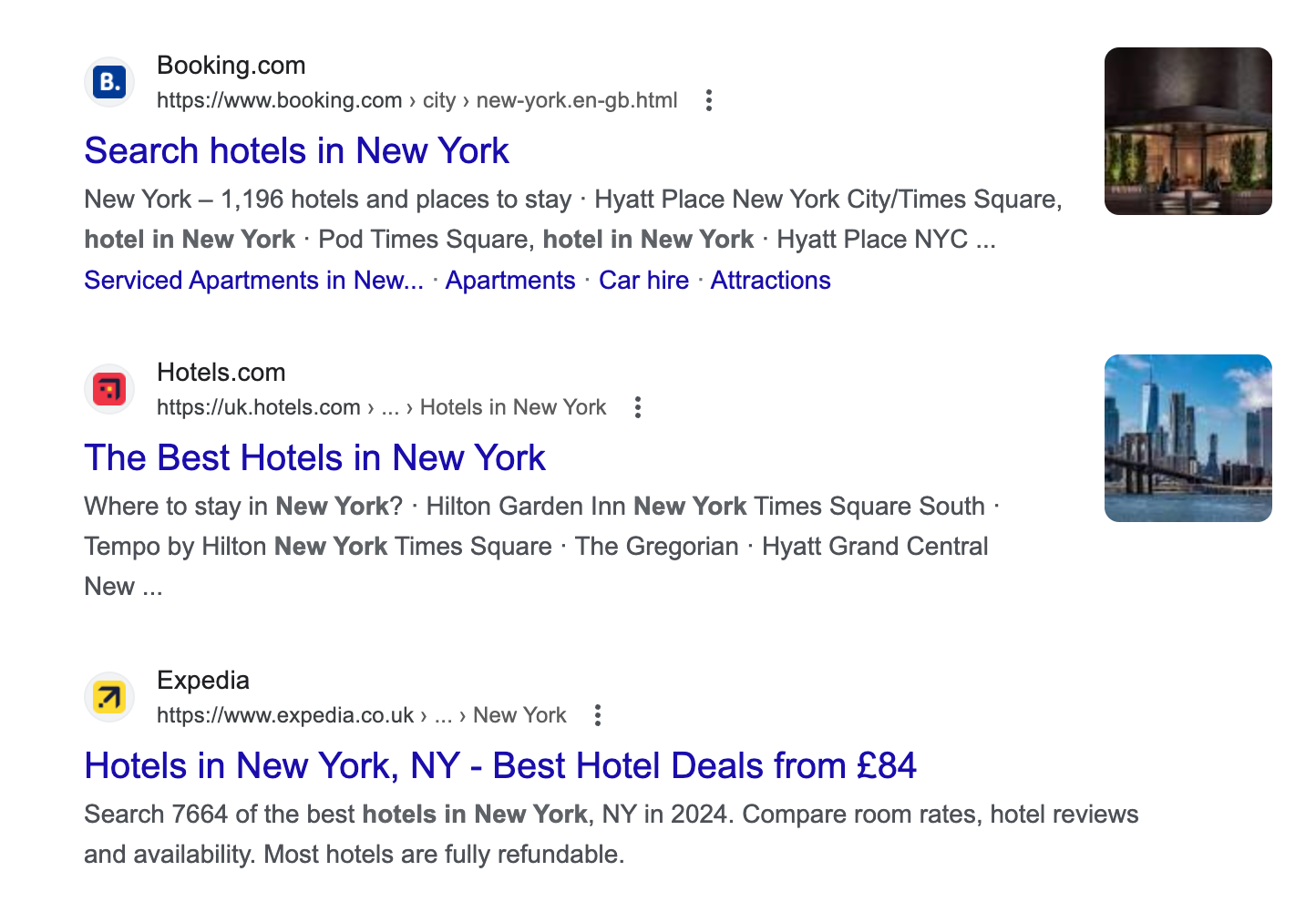
The first thing to be aware of in travel SEO is the tough competition. Especially for the high-volume generic keywords.
But that’s not to say you can’t compete against these industry giants. You absolutely can. You just need to figure out how to do it and focus your efforts.
For example, many specific keywords still have high search volume (but very strong booking intent) that these sites aren’t ranking for.
Why?
Because they’re not targeting them, they don’t have pages worth ranking. You need to find these opportunities and leverage them.
2. You’re competing against Google itself
Not only are you competing against OTA giants for many keywords, but you can also find yourself competing against Google itself.
Take flights, for example:
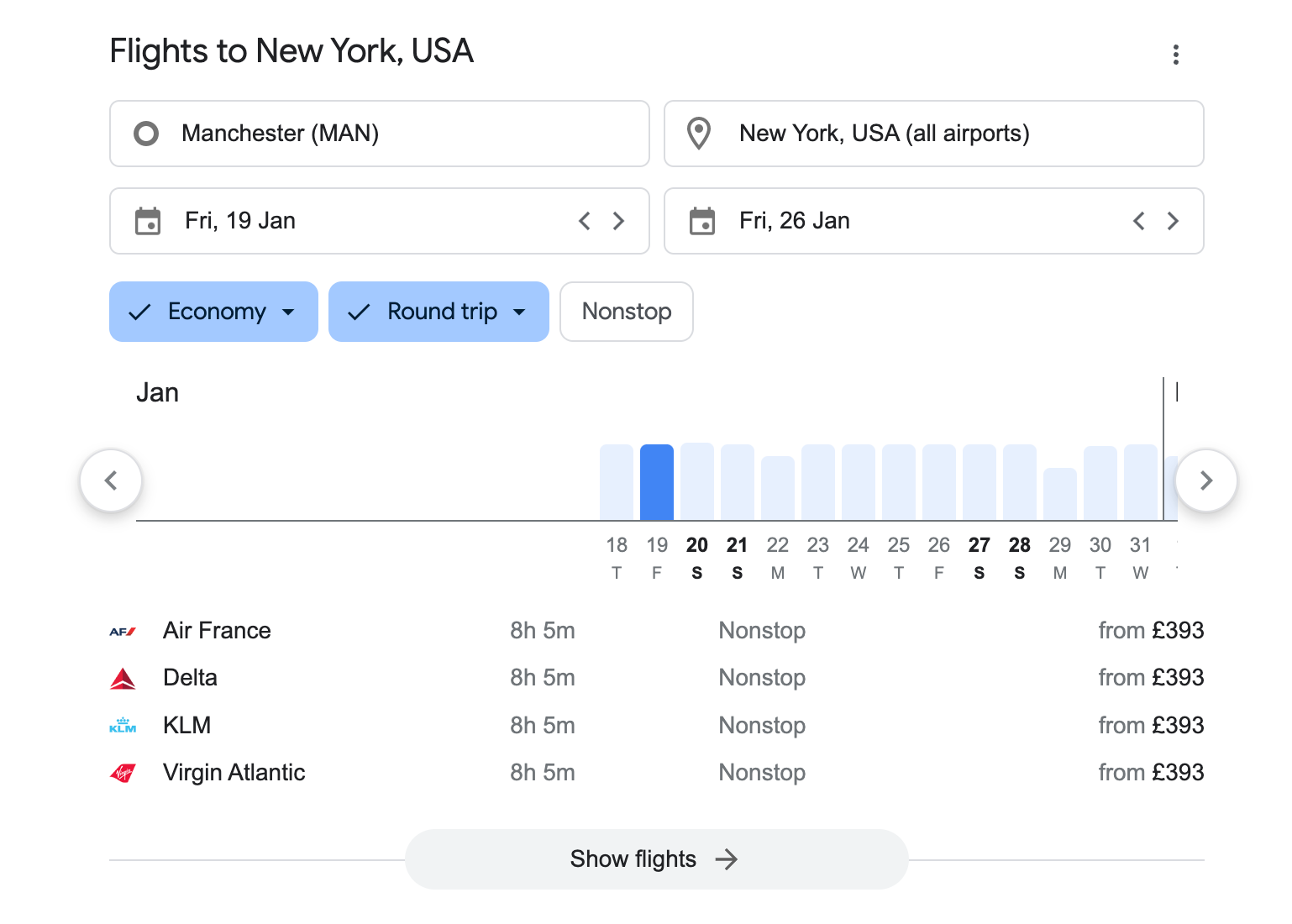
Google wants to keep you on the SERPs, and it does so through Google Flights.
You don’t have to click anywhere to see the starting price of flights from your chosen destination or selected dates. And whilst some users want to browse flights how they’re used to (on the airline’s site, on Skyscanner, etc), many will use this feature.
The impact?
A lower organic CTR for the top rankings compared to if this widget weren’t there. Depending on the travel niche you’re working in, be aware that there are times when Google wants to keep the clicks away from you as much as possible, even if you’re ranking in top spots.
3. Some SERPs have a hotel pack
Not only can you find yourself competing with Google itself or industry giants, but “hotel” and “resort” queries (and variations) usually trigger a hotel pack.
You’re probably familiar with Google’s local pack results that show GMB pages for local searches (e.g. “Indian restaurants in Manchester”), but these travel-related searches show what’s known as a hotel pack.
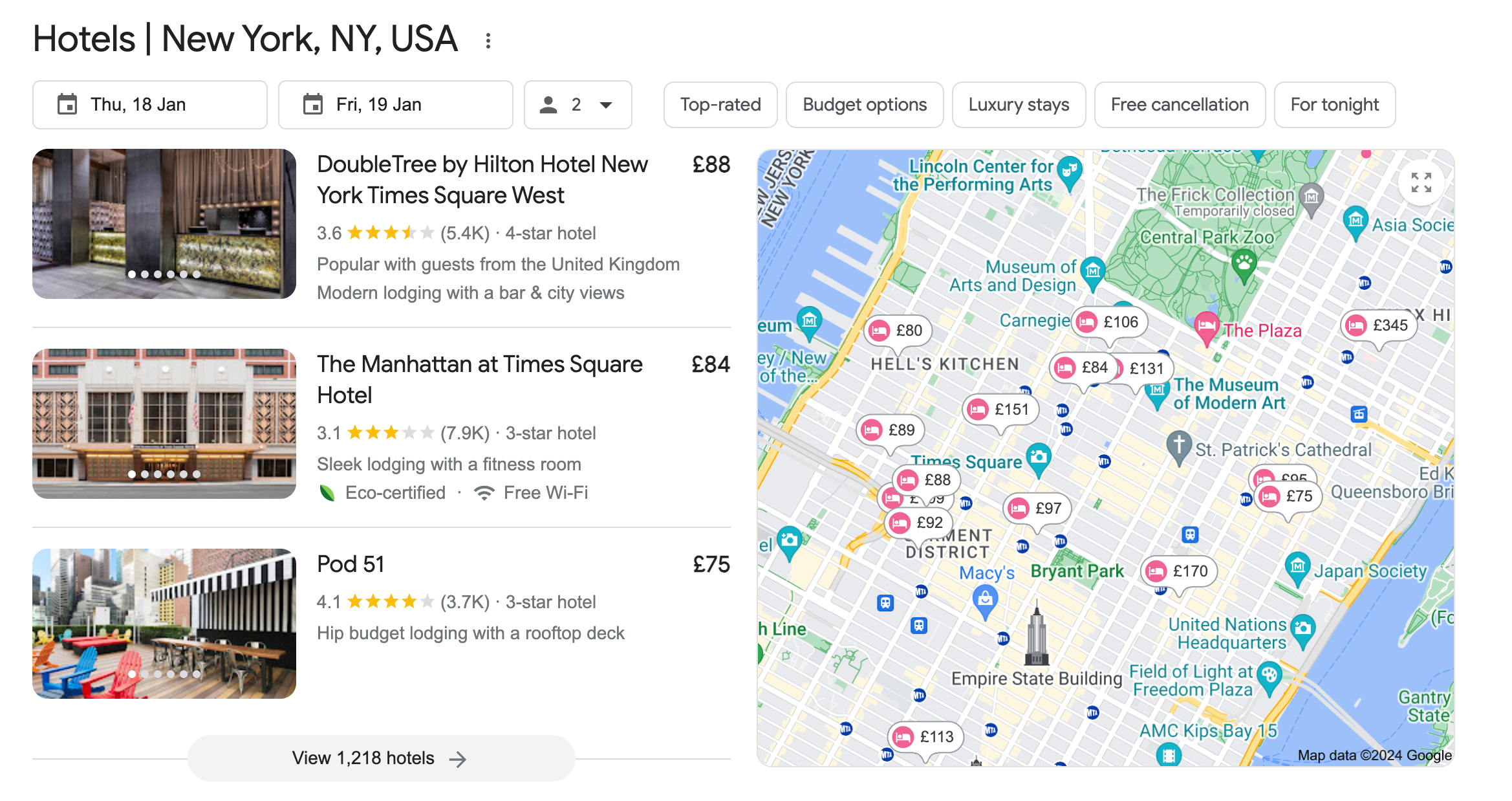
This results pack shows a number of hotel, resort, or accommodation listings in a specific location, with key information such as ratings, prices, star ratings, and more displayed for each.
Check out the hotel pack when running a search for “hotels in New York”:
Or the hotel pack for “resorts in Tulum”:
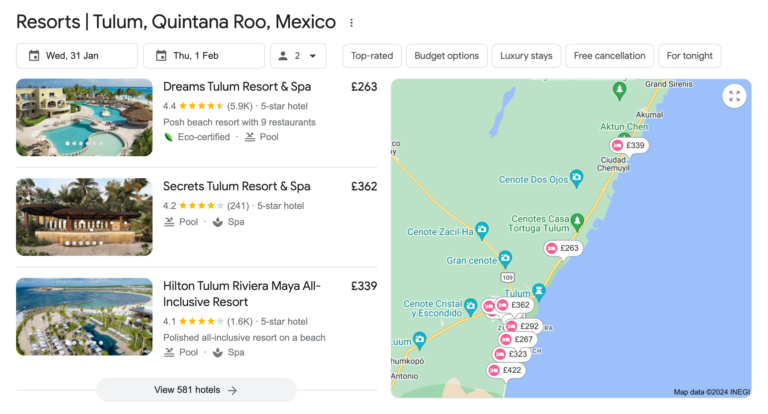
But the hotel pack is more than just a few listings. You can choose your dates and the number of guests, and filter by features such as free cancellation.
These listings open up into a detail page for the hotel, showcasing booking options:
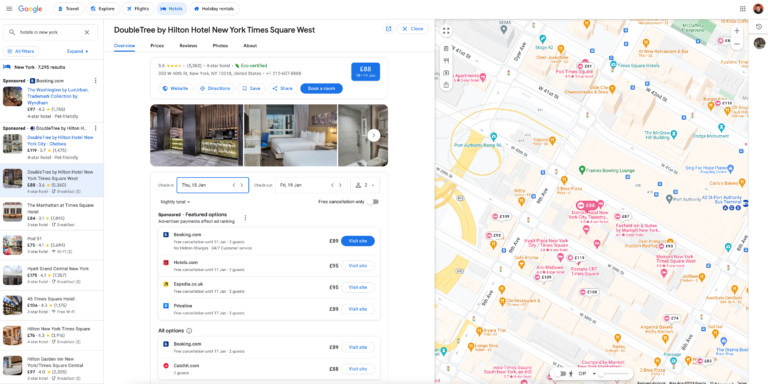
At the top of the results, you’ll find a block of sponsored listings. These are the results that pay to be featured. Below are the organic results.
If you offer accommodation booking, you’ll want to work to get included in the hotel pack listings’ options.
I’m not specifically looking at ranking amongst the ‘free booking links’ on Google Hotel listings in this guide, but if you want to learn more, check out Google’s own guide to this.
Again, you need to be aware that certain Google features, in this case, the hotel pack, can push down organic results, therefore reducing the expected CTR of each position at the top of the SERPs.
4. Seasonality
Seasonality shouldn’t surprise any travel brand, but if you’re an agency person reading this and haven’t worked in travel SEO before, it’s something you need to be aware of.
Search volumes (and, therefore, the traffic you can expect) fluctuate across the year, in line with when most people are researching destinations and booking.
To see what I mean, just look at the last 12 months’ trend in Semrush’s Keyword Overview tool for the query “Hotels in New York”:

See the dip from March to July in monthly search volume?
You need to understand how seasonality affects search volume and ensure you’re accounting for it in your forecasting.
5. Most bookings are carefully considered purchases
Most people don’t spend hundreds or thousands of pounds on a holiday without carefully considering their options. And this is actually a huge opportunity for travel brands to capitalise on.
You see, travel bookings typically go on a journey from researching and choosing a destination to finding the right hotel and beyond. And this presents an opportunity to be visible at every stage.
From inspiring travellers with guides that recommend or suggest destinations at the start of their search journey to offering hotel bookings and suggestions on things to do or places to eat, there are many ways to leverage SEO to be visible when travellers are searching.
A considered purchase and a lengthy conversion path are opportunities to get in front of your target audience as a travel brand, but be aware that there can often be weeks, or even months, between when research starts and when the booking happens. And then, this booking could be made months, or even a year or more, in advance.
There’s also the fact that people spend big on travel. But as with many big buys, there’s a desire to spread this out over multiple payments. If relevant, travel brands should offer payment plans to spread the cost of the trip over several months.
Travel is an umbrella term for a lot of different types of businesses
Travel covers all sorts of different businesses and website types, and we can break this down, at the top level, into:
- High street travel agents (e.g. Tui)
- OTAs (e.g. Booking.com)
- Hotels & resort groups (e.g. ClubMed)
- Hotels & resorts (e.g. Luxor Hotel)
- Attractions (e.g. Disneyland)
- Destination guides (e.g. Visit Orlando)
- Travel publishers (e.g. Lonely Planet)
- Travel blogs (e.g. Hand Luggage Only)
To a certain extent, there’s a lot of crossover between the tactics that work to drive growth for one type of travel site and another. But it’s important to get a feel for the diversity of site types in the SERPs, what each has to offer searchers, and why some undoubtedly rank better than others.
Few sectors, bar perhaps finance, have more diversity in the type of sites that rank for a query.
This also means that some tactics won’t be relevant to you. As we look at these, I’ll make it clear which recommended tactics apply only to a small subset of travel site types.
The Helpful Content Update hit (some) travel sites HARD
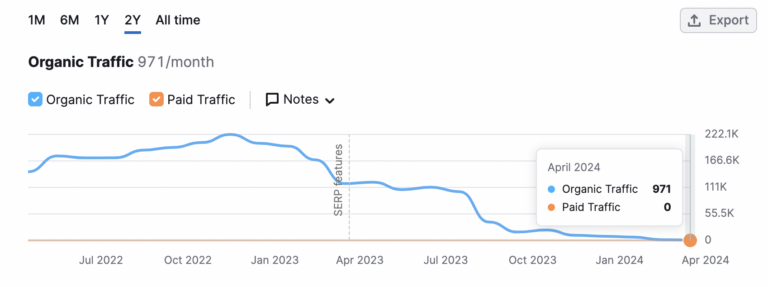
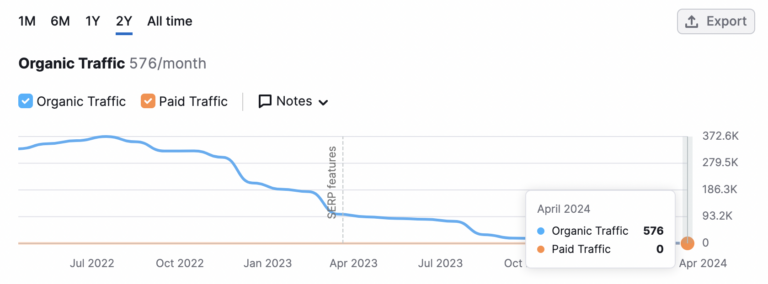
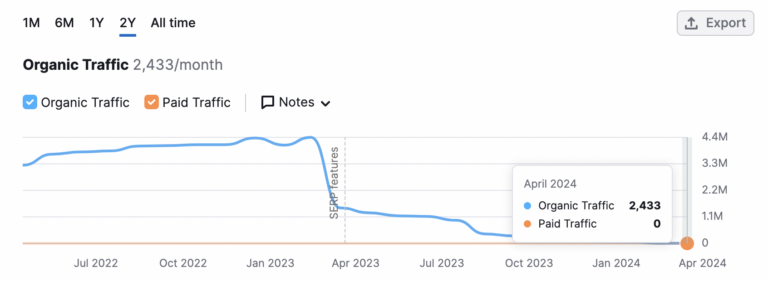
Take a look at these three examples of travel sites that lost significant amounts of traffic during one or more Helpful Content or Core Algorithm Updates over the last two years.
Site 1 saw a 99.6% traffic loss, from 222,085 monthly organic sessions in December 2022 to 971 in April 2024
Site 2 saw a 99.8% traffic loss, from 372,604 monthly organic sessions in August 2022 to 576 in April 2024
Site 3 saw a 99.9% traffic loss, from 4,362,051 monthly organic sessions in March 2023 to 2,433 in April 2024
Out of respect for the sites and their owners, I’m going to keep the URLs private, but hopefully, we can agree that these three travel sites may as well have been completely removed from Google.
And we can’t talk about how to drive SEO success as a travel website without sharing this.
Why?
These are just three of many examples that have seen similar declines during recent Google updates.
The best way to describe these three sites would be as travel blogs.
And Google has made it clear that travel is one of the most targeted sectors with the Helpful Content update. There’s no question about that.
There was a common trend amongst these three, and many more, travel sites that have been hit hard. They did absolutely nothing to demonstrate E-E-A-T, especially not experience.
These three sites all rely heavily on stock images and content that makes it pretty obvious their authors have never actually visited the places they’re writing about.
There’s more to this, though, of course. And if you want more info on this, consider checking out our study on the impact of the HCU on travel publishers.
Does this mean that travel SEO is dead?
Of course not. In fact, it’s the complete opposite. Many travel sites are absolutely thriving on the SERPs following these updates.
But if you want to enjoy success, you need to make sure you can demonstrate E-E-A-T.
Everything you need to know about ranking a travel site on the SERPs
It’s time to learn everything there is to know about ranking a travel site on the SERPs.
Whether you’re responsible for the SEO of an enterprise-level OTA, an airline, a hotel chain or a small tour operator, there are learnings here that you can take away and work into your own strategy.
Travel SEO is competitive, but get it right, and there’s an opportunity to win big…
Keyword research and content strategies for travel brands
It all starts with a plan.
And planning in SEO usually means kickstarting a project with keyword research, competitor analysis and running technical SEO, content and link audits.
But the aim of this guide isn’t to teach you how to do SEO; it’s to look specifically at how you can drive success as a travel brand. This means I’m going to assume you’re comfortable with auditing your site and identifying and analysing your competitors.
Which brings us to keyword research.
After all, you need to understand how people are searching to plan your site’s key pages, supporting content, and overall structure.
And especially in sectors like travel, I’m a big fan of going big with keyword research right from the start of a project and of having a document that serves as the foundation for building a long-term growth plan. I want a good idea of the entire keyword universe the site could target to determine the project’s scale and where to focus efforts.
But there’s a secret about travel SEO: you won’t often hear people talking about… keyword modifiers.
I’ll show you exactly what these are in a minute, but they’re your shortcut to finding hundreds, if not thousands, of keywords as a travel brand.
Before looking at keyword frameworks and how to find and use these, though, you need to get familiar with the four phases of a travel customer’s journey… you’ll want to tie your keyword research and your content strategy back to these, and understanding the steps a consumer goes through before making a booking is key to success.
Micro-moments: The phases of the travel customer journey
You need to be visible across each micro-moment, the four phases of the travel customer journey:
- Dreaming Moments
- Planning Moment
- Booking Moment
- Experiencing Moments
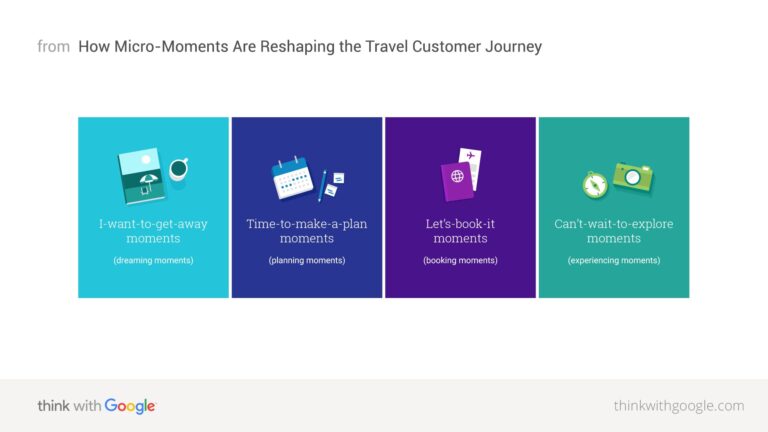
Think of the micro-moments as a framework for building your SEO strategy around, and consider the keywords you need to rank for and the content you need to create to make it happen at each.
Get in front of people when they’re in an “I want to get away” moment and again when they’re in a “time to make a plan” moment, and they’re more likely to return to you in their “let’s book it” moment. And if you want to make organic search a valuable channel, this is one of the fundamentals you need to get to grips with.
Travel bookings rarely happen on the first visit to a website. They’re considered purchases, and the journey can be somewhat lengthy and complex.
And this means you must be visible at every stage of the booking journey to win big and land the booking.
You need to invest in creating content that ranks for keywords across all four micro-moments, and view success holistically. The more visible you are in those early moments, the greater your success will be in the later ones.
Group your keyword research by the four moments and see these as different steps in the journey, from booking a holiday to getting ready to go away. And the more confident you can get at visualising where different keywords fit into that journey, the stronger your strategy will perform.
Someone who ends up booking a holiday to Florida might make the following kinds of searches before and after making their booking:
- Where to go on holiday in April
- Where to visit in Florida
- Hotels in Orlando
- Hotels near Universal Studios
- Hotels on International Drive
- Best Family Hotels on International Drive
- Things to do in Florida with Kids
- Things to do in Orlando
- Universal Studios Orlando Tickets
- Best Restaurants on International Drive
These searches might happen over minutes, days, weeks, or even months, but it’s easy to see that this is about a process in which a consumer refines their searches, starting by looking for inspiration and becoming more specific as they find ideas.
And once they’ve made their booking, the searches don’t stop. Often, they then move on to researching and booking attraction tickets, places to eat, and more.
Search volume vs competition vs intent
Keyword strategy plays a huge role in travel SEO, and one of the most important parts of this is understanding the relationship between search volume, competition, and intent.
Just because a keyword has a high search volume does not automatically mean it is worth targeting.
You need to assess whether you have a realistic chance of ranking and whether the people searching are actually looking for the type of product or service you offer.
Sometimes, broad travel keywords are simply too competitive or too generic to make commercial sense.
Take the keyword “hotels in London” as an example.
According to Semrush, this keyword sees around 74,000 monthly searches in the UK. On the surface, it looks like an obvious opportunity.
But when you actually look at the search results, the picture is very different.
The top results are dominated by OTAs, hotel chains, large booking platforms, and hotel directories. We see sites like Premier Inn, Hotels.com, Lastminute.com and Tripadvisor ranking because they can offer users hundreds of hotel options across London.
Even when individual hotel brands appear, they tend to be large hotel groups or well-established London hotels with strong authority, rather than smaller, independent properties.
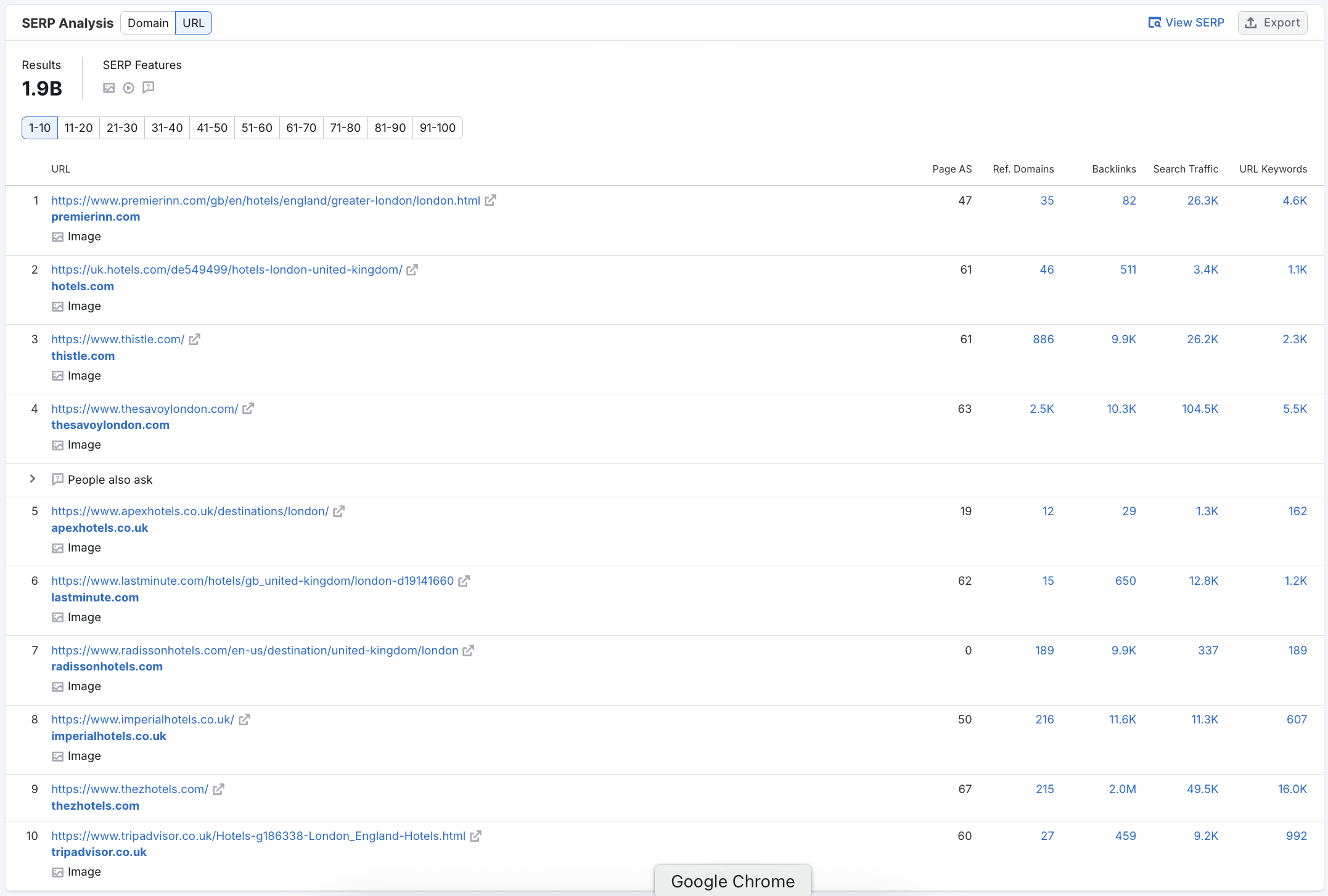
Even when individual hotel brands appear, they tend to be large hotel groups or well-established London hotels with strong authority, rather than smaller, independent properties.
For a single hotel in London, ranking for “hotels in London” is both highly unlikely and commercially questionable.
The search intent is too broad. Someone searching for this query could be looking for:
- Budget hotels
- Luxury hotels
- Family hotels
- Hotels near a specific station
- Hotels in a particular borough
- Hotels with parking
- Hotels with a spa
- Business hotels
- Boutique hotels
Google understands this, which is why it prioritises sites that give users lots of choice and filtering options.
An individual hotel is unlikely to satisfy enough of that intent.
In contrast, more specific keywords can be much more achievable and commercially valuable.
Take “Blackpool hotels with entertainment” as an example.
While the search volume is lower, around 8,100 monthly searches, the intent is much more specific.
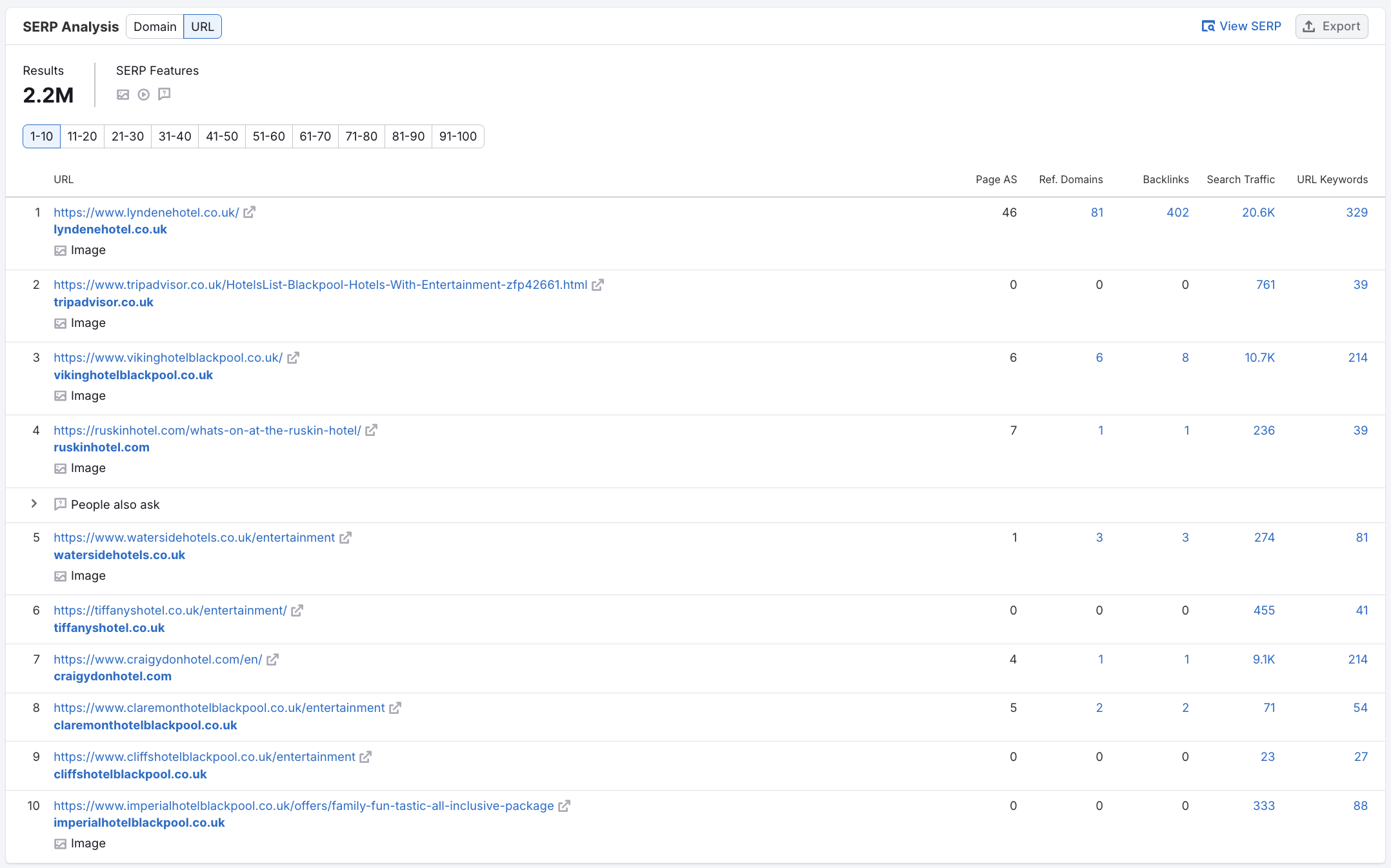
Users are not simply looking for any hotel in Blackpool. They are looking for a hotel with a particular feature.
As a result, the search results are much more accessible for individual hotels. Rather than being dominated by OTAs and comparison sites, the SERPs include a much higher number of single hotel websites and more niche pages built around entertainment offerings.
This is because individual hotels can genuinely satisfy the search intent.
A hotel with live entertainment, cabaret, family shows, or themed evenings is much more relevant for this type of search than a broad directory page.
This is why travel SEO should never be driven solely by search volume.
You need to ask:
- Can we realistically rank for this keyword?
- Does the search intent align with our offering?
- Would the traffic be likely to convert?
- Are the current results dominated by brands we cannot realistically compete with?
- Would a more specific keyword offer a better opportunity?
In many cases, smaller travel brands, independent hotels, tour operators, and niche providers will see far better results by targeting more specific, lower-volume keywords with clearer search intent rather than chasing the biggest search volumes.
Not sure what intent means?
Quite simply, search intent refers to the reason or purpose behind a user’s search query. It represents what the user is looking to accomplish, or find, when they search for a specific keyword or phrase.
Understanding search intent helps you to ensure that the type of content you’re creating to target a specific keyword, for example, whether you launch an informational guide or a grid of hotel options, matches what a user is looking for and, in turn, what Google wants to rank.
In fact, getting intent wrong is pretty much a guaranteed way not to rank.
There are four main types of search intent:
- Informational intent: The user is looking for information or answers to specific questions. Examples include queries like “when is the best time to visit Rome?”.
- Navigational intent: The user is looking for a specific website or page. For instance, a user searching for “TUI”.
- Transactional intent: The user wants to make a purchase or complete a transaction. Examples include searches like “hotels in Paris”.
- Commercial investigation: The user is considering a purchase and seeking information to help them make a decision. This might include searches like “best hotels in Paris”.
And you can understand the intent behind a query simply by looking at what currently ranks on Google. You’ll usually see trends. But be aware that it is possible to have mixed-intent SERPs, where a mix of different intents shows on the first page of results.
Understanding and optimising for search intent is crucial for effective travel SEO, as it ensures content aligns with what users are actually seeking, thereby improving relevance and increasing the likelihood of higher rankings.
And this leads us to the topic of keyword cannibalisation.
The challenge of avoiding keyword cannibalisation
It’s really easy to cause keyword cannibalisation issues in the travel space.
This is when you’re (usually accidentally) competing against yourself on the SERPs. When you’ve got more than one page targeting the same keyword with the same intent, and sending conflicting signals to the search engines as to which should be ranked.
For a number of reasons that I won’t explore here (it’s a whole post in itself), this can result in neither page ranking as highly as it otherwise would.
Want an example of keyword cannibalisation in travel? Here are two keywords…
- Family hotels in Greece
- Family resorts in Greece
To target these terms, should you create two pages or one?
On the face of it, you could assume that you’d need to create two pages here; one targeting ‘resorts’ and the other targeting ‘hotels.’
But it’s not quite that simple.
You see, in many ways, family resorts and family hotels are one and the same. Could you expect someone searching ‘family hotels in Greece’ to want to be shown resorts? And not just the hotel group properties in the cities?
I’d argue that most people searching for ‘family hotels in Greece’ actually want to explore the resorts on offer, those with kids’ clubs, beach access, and other facilities for the kids.
But you can’t just guess at this.
Why?
Because there’s no blanket rule here. It depends on the query being searched for.
Another example? Here are two more keywords…
- Hotels in Cancun
- Resorts in Cancun
What are you thinking?
This one’s a little harder to figure out. The overlap isn’t as clear: the searcher could be looking for an all-inclusive resort for two weeks, or for a hotel in the city for a night or two.
There’s a lot to suggest that the results should be different here.
Rather than guessing (please, don’t do that), be guided by the data.
That way, if you need to create two pages, go ahead and do this. But if Google understands that the intent of two or more queries is the same, just create one.
You can use the Keyword Insights keyword clustering tool to get this data. Here’s what the tool does, in its own words:
When creating new content, knowing when a particular piece should be broken out into more specific sub-topics can be challenging. For example, if we had the keywords “architect fees” and “how much do architects cost?”, would you know quickly whether you need 2 different pages to target them, or if they could be targeted on the same page?
Keyword Insights makes this quick and painless. We use live search results pages and group keywords based on what’s ranking. So you’ll know, in seconds, when a page should be broken out into sub-topics to stand the best chance of ranking.
A proven keyword research process for travel websites
When it comes to keyword research, travel is by far one of the easiest sectors.
Why?
Because pretty much every keyword (not all, but most) is based around a destination. This means that any keyword you find can be used multiple times, just by switching to a different destination.
Want to learn more about how this works?
Common keyword modifiers for travel brands
Keyword modifiers are your shortcut to rapid keyword research. And whilst these can be used in quite a few industries, travel is by far the one where they’re the most effective.
Keyword modifiers work like this:
{keyword} + {modifier}
And the most common ones you’ll probably want to use are these…
| Keyword modifier | Example |
|---|---|
| Holidays to {country} | Holidays in Greece |
| Holidays to {region} | Holidays in Florida |
| Holidays to {city} | Holidays in Miami |
| Hotels in {country} | Hotels in the USA |
| Hotels in {region} | Hotels in Florida |
| Hotels in {city} | Hotels in Miami |
| Hotels in {suburb} | Hotels in Miami Beach |
| Villas in {country} | Villas in the USA |
| Villas in {region} | Villas in Florida |
| Villas in {city} | Villas in Orlando |
| Villas in {suburb} | Villas in Kissimmee |
| All Inclusive Holidays to {country} | All Inclusive Holidays to Greece |
| All Inclusive Holidays to {region} | All Inclusive Holidays to Corfu |
| All Inclusive Holidays to {city} | All Inclusive Holidays to Sidari |
| Last Minute Holidays to {country} | Last Minute Holidays to Greece |
| Last Minute Holidays to {region} | Last Minute Holidays to Corfu |
| Last Minute Holidays to {city} | Last Minute Holidays to Sidari |
| Things to do in {country} | Things to do in Greece |
| Things to do in {region} | Things to do in Corfu |
| Things to do in {city} | Things to do in Sidari |
| Family Holidays to {country} | Family Holidays to Greece |
| Family Holidays to {region} | Family Holidays to Corfu |
| Family Holidays to {city} | Family Holidays to Sidari |
| Family Hotels in {country} | Family Hotels in Greece |
| Family Hotels in {region} | Family Hotels in Corfu |
| Family Hotels in {city} | Family Hotels in Sidari |
| Luxury Hotels in {country} | Luxury Hotels in Greece |
| Luxury Hotels in {region} | Luxury Hotels in Corfu |
| Luxury Hotels in {city} | Luxury Hotels in Sidari |
| Resorts in {country} | Resorts in Greece |
| Resorts in {region} | Resorts in Corfu |
| Resorts in {city} | Resorts in Sidari |
| Family Resorts in {country} | Family Resorts in Greece |
| Family Resorts in {region} | Family Resorts in Corfu |
| Family Resorts in {city} | Family Resorts in Sidari |
| All Inclusive Resorts in {country} | All Inclusive Resorts in Greece |
| All Inclusive Resorts in {region} | All Inclusive Resorts in Corfu |
| All Inclusive Resorts in {city} | All Inclusive Resorts in Sidari |
| Adult Only Resorts in {country} | Adult Only Resorts in Greece |
| Adult Only Resorts in {region} | Adult Only Resorts in Corfu |
| Adult Only Resorts in {city} | Adult Only Resorts in Sidari |
| Best Hotels in {country} | Best Hotels in Greece |
| Best Hotels in {region} | Best Hotels in Corfu |
| Best Hotels in {city} | Best Hotels in Sidari |
| Flights to {destination} | Flights to Las Vegas |
| Flights from {destination} to {destination} | Flights from Manchester to Las Vegas |
| Car Hire in {destination} | Car Hire in Orlando |
| Things to do in {destination} | Things to do in Orlando |
| Free Things to do in {destination} | Free Things to do in Orlando |
| Things to do With Kids in {destination} | Things to do With Kids in Orlando |
Now, these are by no means the only keyword modifiers travel brands can use. I could easily quadruple this list and more.
But they’re a great starting point and hopefully, inspiration to help you spot these shortcuts when conducting keyword research and planning your content strategy.
And it’s really easy to see how this concept works.
Find a keyword and replace the destinations with others where you have an offering. Very quickly, you can build a starting list for your keyword research.
Of course, I’m talking about how to build out a seed keyword research list here. I’m not saying you should go ahead and use destination variables within content… that’s a whole different topic.
But when it comes to doing keyword research, this is a powerful way to speed up the process, especially if you operate across a large number of destinations.
Once you’ve got your list, run it through your favourite keyword research tool (I’m a fan of Semrush for this, but Ahrefs and others work just as well) to collect the data, which, in turn, can help you to prioritise your focus areas.
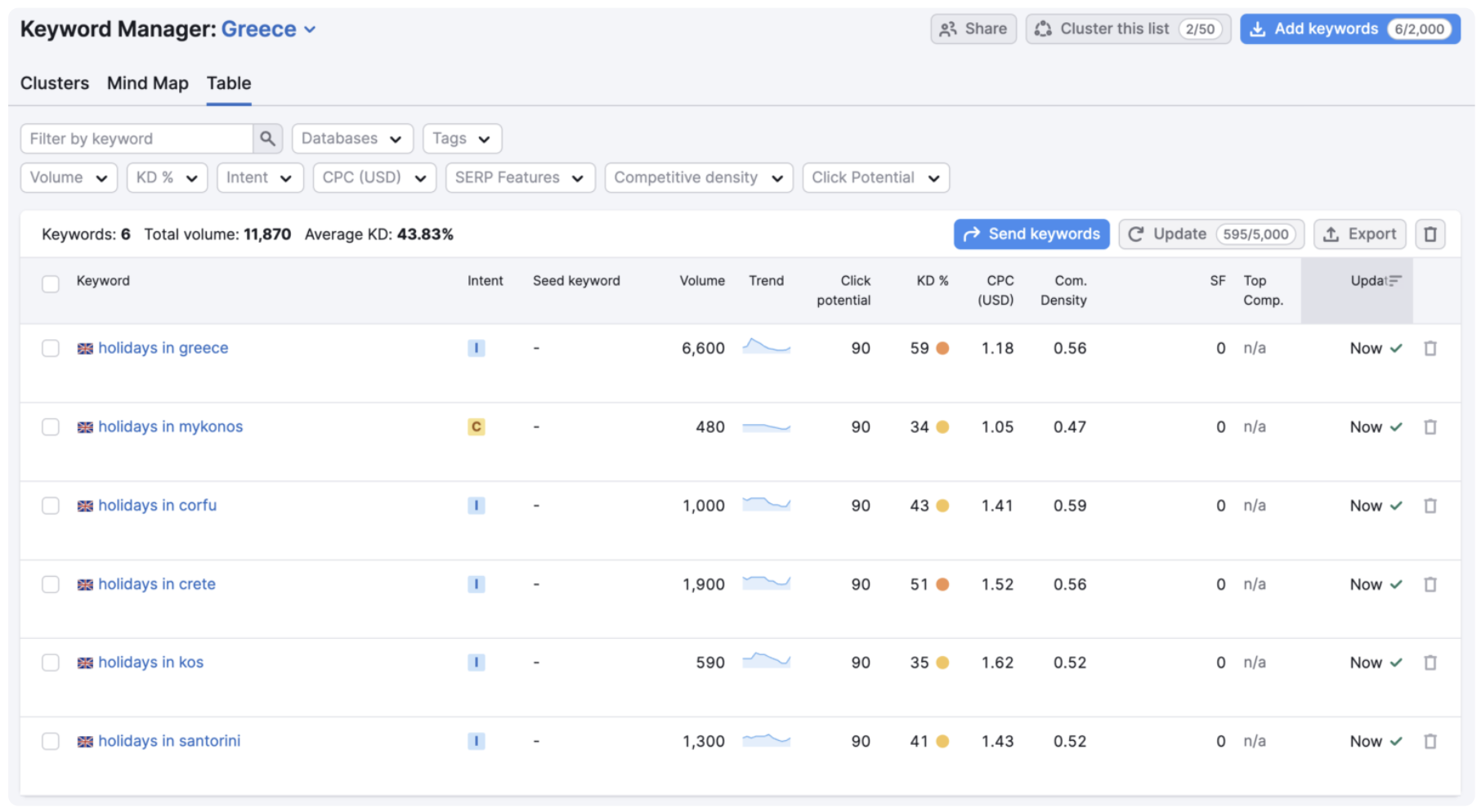
I’m also a big fan of Semrush’s clustering tool at this stage to help find other keyword (and modifier) ideas.
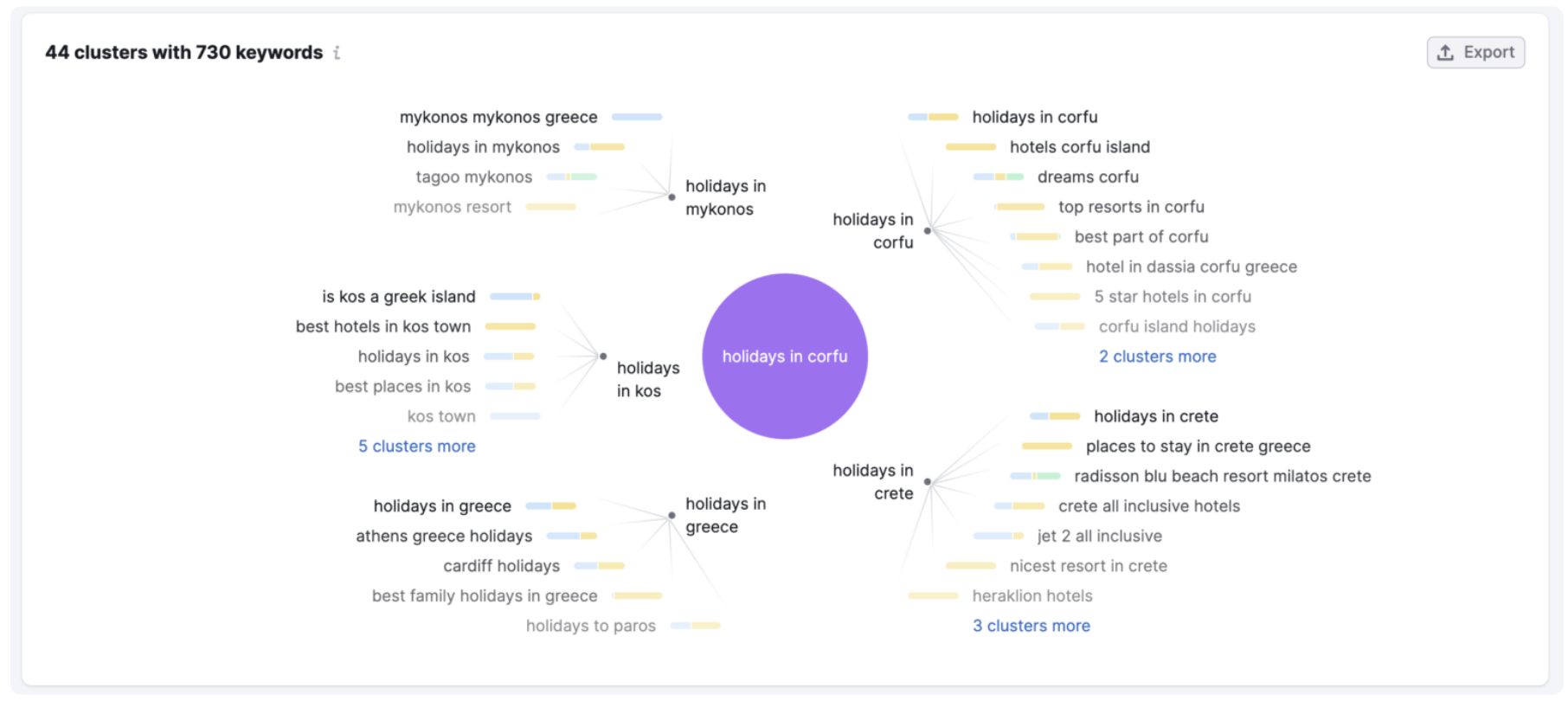
Of course, you should go beyond this to find keywords that don’t fit into these frameworks, but it’s a great starting point that can significantly speed up the process!
Building a travel content strategy
Step 1: Define the essential pages and content types
Building on keyword research, let’s now take a look at the different page and content types that travel brands will typically need to create as part of their strategy.
Of course, not all will be relevant to every travel site, but this covers the bulk of them. Make sure you skip past any examples that aren’t relevant to your specific offerings.
A huge number of travel-related searches are used to find destination pages, and this applies to most travel websites.
These pages are targeted to a continent, region, country, city, or even a suburb, and usually act as hub pages for that destination. They’re the pages that act as the main page for each destination, where you’ll link to more specific locations and offerings, and provide information and inspiration.
Examples of destination page recommendations and their target keywords include:
| Primary keyword / Page heading | Page URL |
|---|---|
| Florida Holidays | /usa/florida/ |
| Orlando Holidays | /usa/florida/orlando/ |
| Miami Holidays | /usa/florida/miami/ |
| Florida Keys Holidays | /usa/florida/keys/ |
| International Drive Holidays | /usa/florida/orlando/international-drive/ |
| Fort Lauderdale Holidays | /usa/florida/fort-lauderdale |
| Clearwater Holidays | /usa/florida/clearwater/ |
| Daytona Beach Holidays | /usa/florida/daytona-beach/ |
| Tampa Holidays | /usa/florida/tampa/ |
These are the top-level pages for some of the main destinations in Florida, as an example.
You’ll notice that the URL structure in these examples reflects the relationship of destinations to one another, too. All of these are nested within the /usa/ folder (country), and you’ll see /usa/florida/orlando/international-drive/ nested even deeper, given that International Drive is a popular tourist hotspot in Orlando.
As a general rule, you want to nest destinations like this:
/{country}/{region}/{city}/{suburb}
If you only operate in one country or region, exclude these as it makes sense to do so.
Want to see a few examples?
Check out Thomas Cook’s destination page to give you a good idea of how to structure this type of content and what to include:
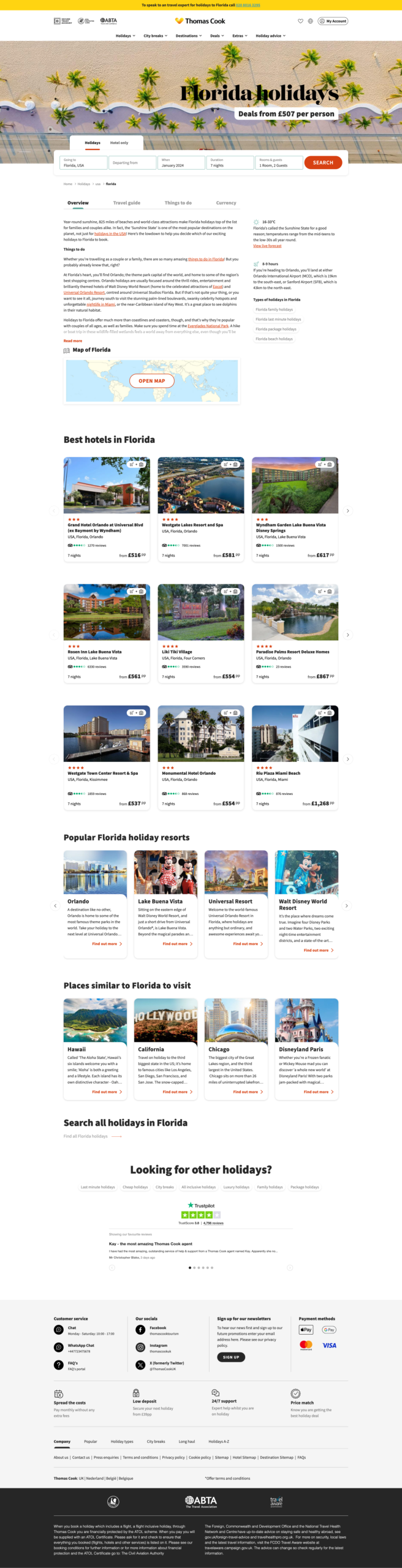
The purpose of destination pages is to really sell the place itself and to inspire. These are usually browsed during “dreaming” and “planning” moments and should be seen as a top-level overview of a location.
Typically, you’ll want to include the following on this type of page:
- An overview of the destination
- Links to the key locations within this destination where you have offerings
- A round-up of top ‘offerings’ in the destination
- Key facts about the destination
- Links to sub-pages of the destination that aren’t for other locations
Of course, make these specific to your business, but that’s a good starting point.
Once a tourist has decided on one or more destinations they’re considering travelling to, one of the next searches they make is typically about accommodation.
And this means searches for ‘hotels in…,’ ‘villas in…’ or other accommodation types.
These pages are typically accommodation listings that showcase all the options available in that destination, with filtering to refine results based on what users are looking for.
Examples of accommodation-type page recommendations and their target keywords include:
| Primary keyword / Page heading | Page URL |
|---|---|
| Hotels in Florida | /usa/florida/hotels/ |
| Hotels in Orlando | /usa/florida/orlando/hotels/ |
| Hotels in Miami | /usa/florida/miami/hotels/ |
| Villas in Orlando | /usa/florida/orlando/villas/ |
| Villas in Kissimmee | /usa/florida/kissimmee/villas/ |
You’ll notice in these examples that they’re nested within the destination subdirectory. And this is always preferential, helping to keep content organised and in a URL structure that expands out from the destinations themselves.
Check out this destination page from TUI to give you a good idea of how to structure this type of page and what to include:

Accommodation type pages help tourists find options for where to stay once they’ve decided on a destination and accommodation type. They are usually browsed during “planning” moments and as the user approaches “booking” moments. They should be treated as category pages that include all available accommodation of that type.
Not everyone’s search for a holiday starts with a destination in mind.
Sometimes, they’re looking for inspiration on where to go, based on their criteria for a certain type of holiday.
This could be a family holiday, a beach holiday or another type.
These searches happen during ‘dreaming’ and ‘planning’ moments and offer travel brands an opportunity to really influence the destinations travellers consider for their next holiday.
At this stage in their journey, they’re likely still open to different destinations and want to be inspired and pointed towards suitable options.
Really, it’s a chance to recommend.
Examples of holiday-type page recommendations and their target keywords include:
| Primary keyword / Page heading | Page URL |
|---|---|
| Family Holidays | /family-holidays/ |
| Adult-Only Holidays | /adult-only-holidays/ |
| Beach Holidays | /beach-holidays/ |
| Couples Holidays | /couples-holidays/ |
| Ski Holidays | /ski-holidays/ |
The reality is, is that these are going to be limited to what a company has to offer. Some sites, therefore, will naturally have more opportunities with these page types than others.
But it’s all about thinking about the different ways people search and what they expect from each. Then, make sure you’re matching this intent.
Take a look at these two examples of holiday-type pages from Kuoni and TUI for ‘adult-only holidays’ and ‘family holidays’ for inspiration:
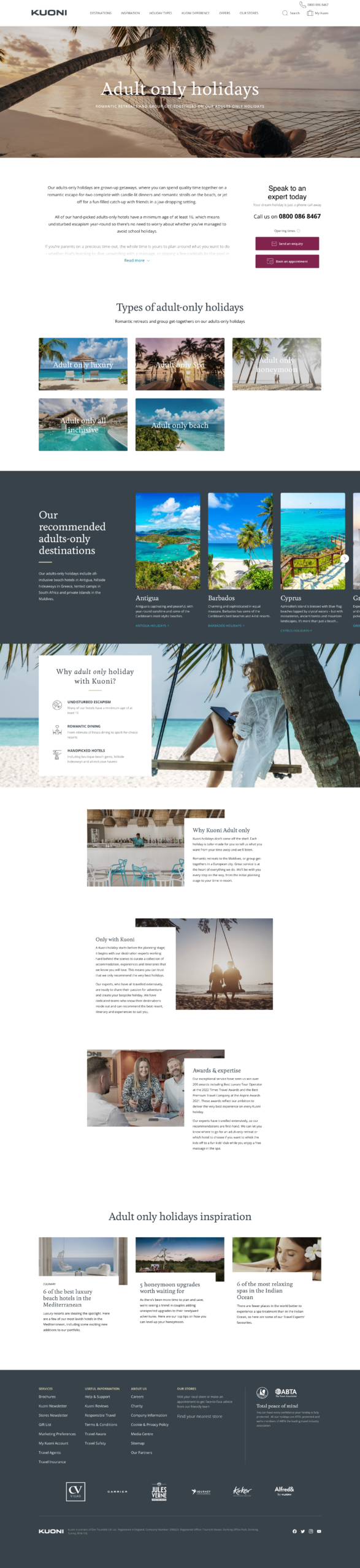
When planning out and building this type of page, consider including things like:
- Links to recommended destinations for that travel type
- Information on what makes your offering tailored to this type of travel
- Links to informational / guide content that expands on this type of travel to help users make decisions on where to go
It’s all about selling the benefits of this type of holiday, giving recommendations, inspiring, and helping share top tips on where to go for it.
Some holidaymakers will pretty much combine destination and holiday type searches once they’ve made some decisions on where they want to go on holiday.
They’re looking for a specific holiday type (a family holiday, for example) in a certain location.
And here are a few examples of this type of content:
| Primary keyword / Page heading | Page URL |
|---|---|
| Family Holidays to Florida | /usa/florida/family-holidays/ |
| Family Holidays to Orlando | /usa/florida/orlando/family-holidays/ |
| Couples Holidays to Florida | /usa/florida/couples-holidays/ |
Really, they’re an extension of ‘holiday type’ pages, but with the specifics relating to a destination, not in a general sense.
As examples, take a look at these two pages from TUI and Thomas Cook:
Really, they’re an extension of ‘holiday type’ pages, but with the specifics relating to a destination, not in a general sense.
As examples, take a look at these two pages from TUI and Thomas Cook:
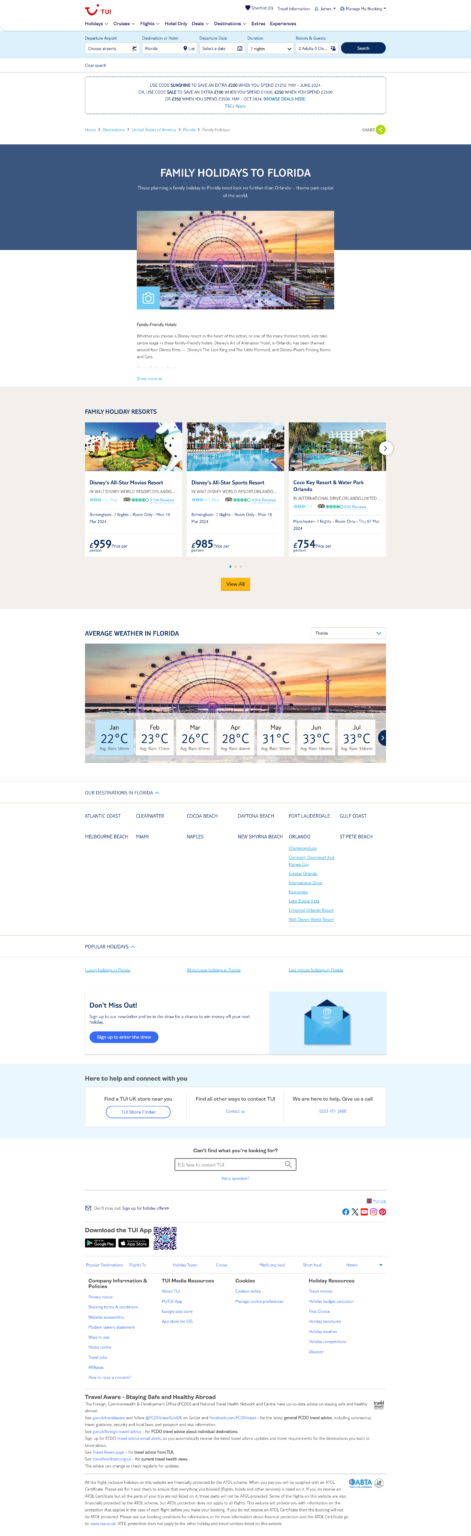
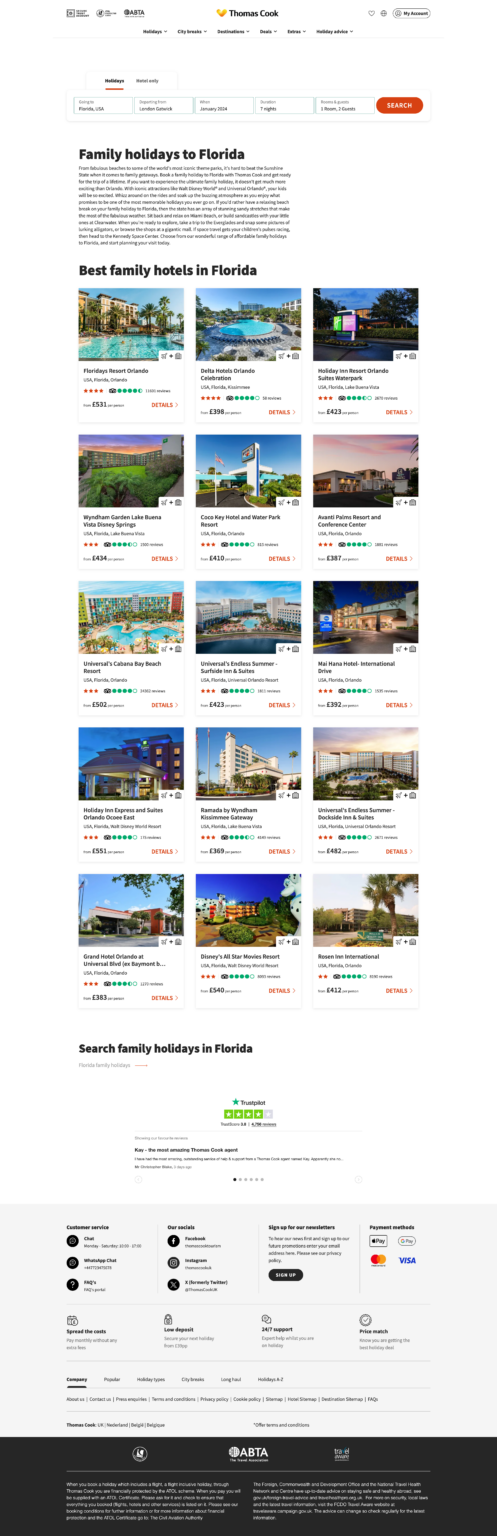
Whilst at first glance these two pages look a little different, the basic concept is the same; they’re just laid out differently. Key things to include for this type of page are:
- A summary of why the destination is a great choice for that type of holiday
- Accommodation or package listings for that type of holiday in that destination
These ones are easy to understand, but have to be included, given that flights are such a big part of the travel industry.
As a heads up, though, the flight space is pretty damn competitive, with Google itself taking up so much search real estate.
There’s also competition from airlines themselves, their partners, and giants like Skyscanner and Kayak.
These searches typically occur when someone is looking to book a flight on their own, not as part of a package.
But it’s important not to focus solely on the ‘to’ and ‘from’ destinations in isolation.
Just look at some examples of recommended flights pages for the right travel brand:
| Primary keyword / Page heading | Page URL |
|---|---|
| Flights to Florida | /flights/destinations/florida/ |
| Flights from Manchester to Orlando | /flights/routes/manchester-to-orlando/ |
| Flights from London to Orlando | /flights/routes/london-to-orlando/ |
It’s not just people searching for ‘flights to {destination}’. They’re also defining their starting airport.
But just what is expected on pages like these? Here are two examples from Kayak and Virgin Atlantic:
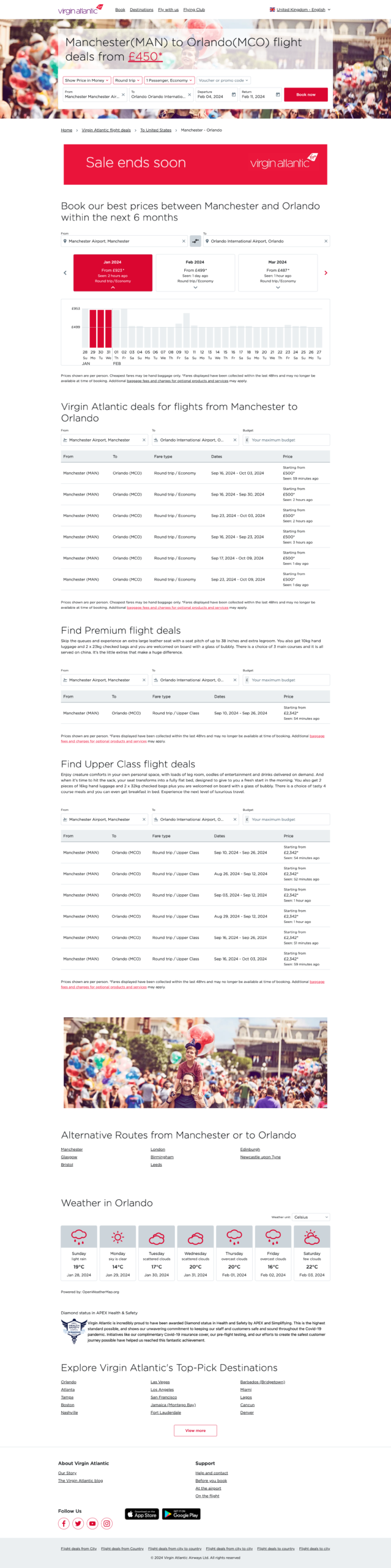

There’s a lot here. Lots of data. Lots of different flight options. And lots of value.
In fact, that’s probably what’s most important here if you want to compete against these giants…my advice is to figure out how you can add more value than the other results.
Like with flight pages, car hire pages shouldn’t need much of an introduction.
If you offer car hire through your site, you’ll need these and need to understand how to set them up for success. If you don’t, you don’t need to think about them.
Just like flights, the car hire space is competitive. But it’s also a huge opportunity to understand just how people search.
Look at these keyword examples:
| Primary keyword / Page heading | Page URL |
|---|---|
| Car Hire in Florida | /car-hire/usa/florida/ |
| Car Hire in Orlando | /car-hire/usa/florida/orlando/ |
| Car Hire at MCO (Orlando) Airport | /car-hire/usa/florida/orlando/mco/ |
| Car Hire on International Drive, Orlando | /car-hire/usa/florida/orlando/international-drive/ |
Even in these four examples, we’ve got searches for:
- Car hire in the state
- Car hire in the city
- Car hire at the airport
- Car hire in a specific location in the city
And here are a few examples of how top-ranking sites are setting up their car hire pages:
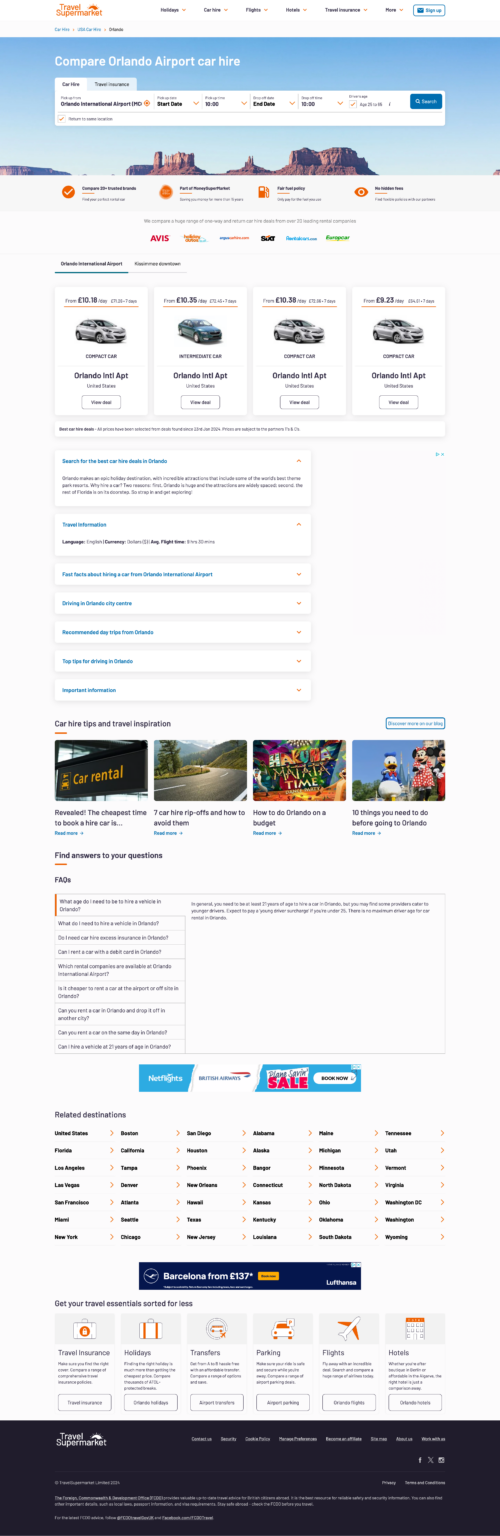
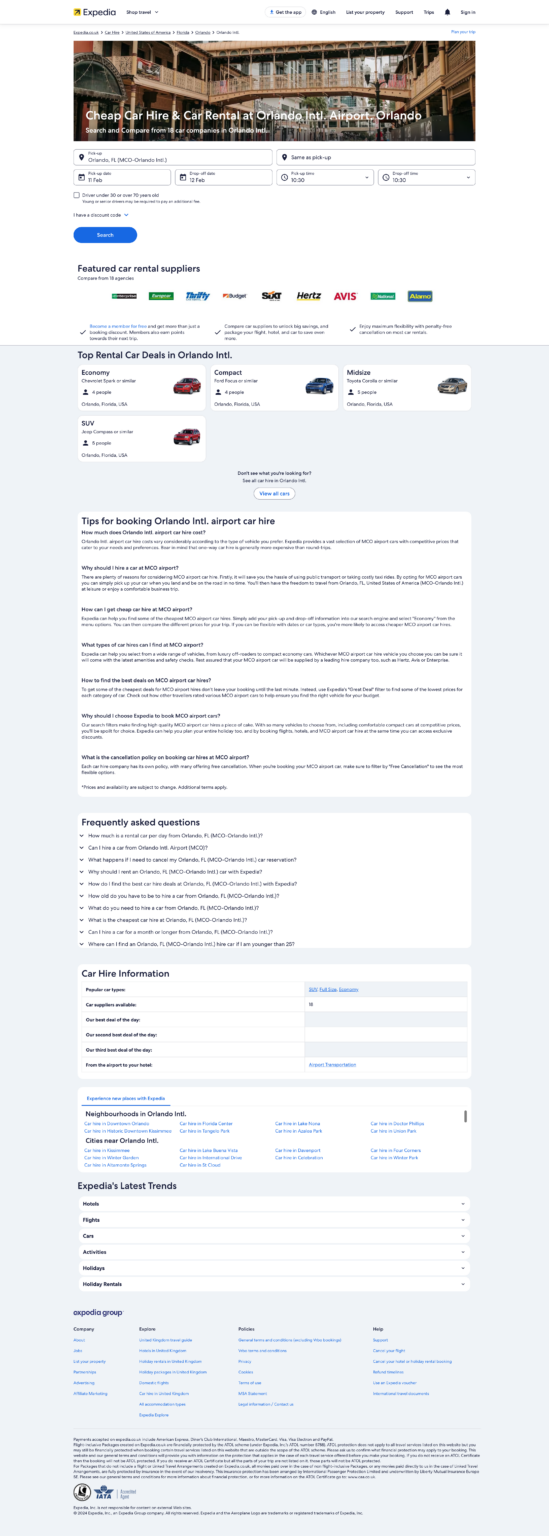
Of course, these pages need to be based around the ability to search for car hire in the location for specific dates; that’s a given. But beyond this, there’s a need to look at how value can be added. Some of the examples here include:
- Top deals and their pricing
- Tips to find the best deals
- FAQs
- Other key information about the airport or location
There’s a real opportunity for travel brands to appear in front of potential tourists at every stage of their booking journey, as I’ve already talked about with the Micro Moments.
And this involves having a solid, full-funnel content strategy that lets you target people doing research beyond just looking for resort, hotel, or holiday listings.
One essential content type here is “Best…” pages.
Have a look at these keyword examples:
| Primary keyword / Page heading | Page URL |
|---|---|
| Best Hotels in Florida | /guides/best-hotels-in-florida/ |
| Best Hotels in Orlando | /guides/best-hotels-in-orlando/ |
| Best Family Hotels in Orlando | /guides/best-family-hotels-in-orlando/ |
| Best Hotels on International Drive, Orlando | /guides/best-hotels-on-international-drive/ |
| Best Water Parks in Florida | /guides/best-water-parks-in-florida/ |
When someone searches for “Best…”, they’re looking for recommendations. For editorial write-ups, in most cases.
And by understanding there’s a different intent between “Hotels in Florida” and “Best Hotels in Florida,” you’re able to leverage the opportunity to create both an informational guide and a hotel listings page, if that’s what you offer.
Here are a few examples:


The reality is that these are pretty standard informational guides. Just be sure to take the time to look at what already ranks on the SERPs and consider how you can add value beyond what’s already there.
The “Best…” pages I gave the example of above are one type of informational content, but the reality is that there’s a lot more. Content types that don’t fit any one particular framework.
Here are a few examples:
| Primary keyword / Page heading | Page URL |
|---|---|
| Destinations that are hot in December | /guides/hot-destinations-in-december/ |
| What to pack for a cruise | /guides/what-to-pack-for-a-cruise/ |
| Ski resorts with the most snow | /guides/ski-resorts-with-the-most-snow/ |
| When is the best time to go to the Maldives? | /guides/best-time-to-go-to-the-maldives/ |
| Weather in December in Orlando | /guides/weather-in-december-in-orlando/ |
Going back to the concept of full-funnel content marketing, we’ve got tourists at different stages of their booking journey looking for information and for inspiration.
Just like this:

You need to make sure you’re leveraging informational content as part of your travel SEO strategy, so you’re the brand getting in front of potential customers at every stage of their search for their next holiday or trip.
Whilst it’s easy to focus pretty much solely on non-branded search terms with SEO, that shouldn’t be the case.
If you’re not ranking for your own brands’ discounts and reviews terms, you’re essentially letting someone else collect an affiliate commission or have the limelight when someone looks for a review.
And that’s why every travel brand, at least those where transactions take place, should be publishing their own pages that rank for:
- {brand} discount codes
- {brand} reviews
Just like these examples from TUI:
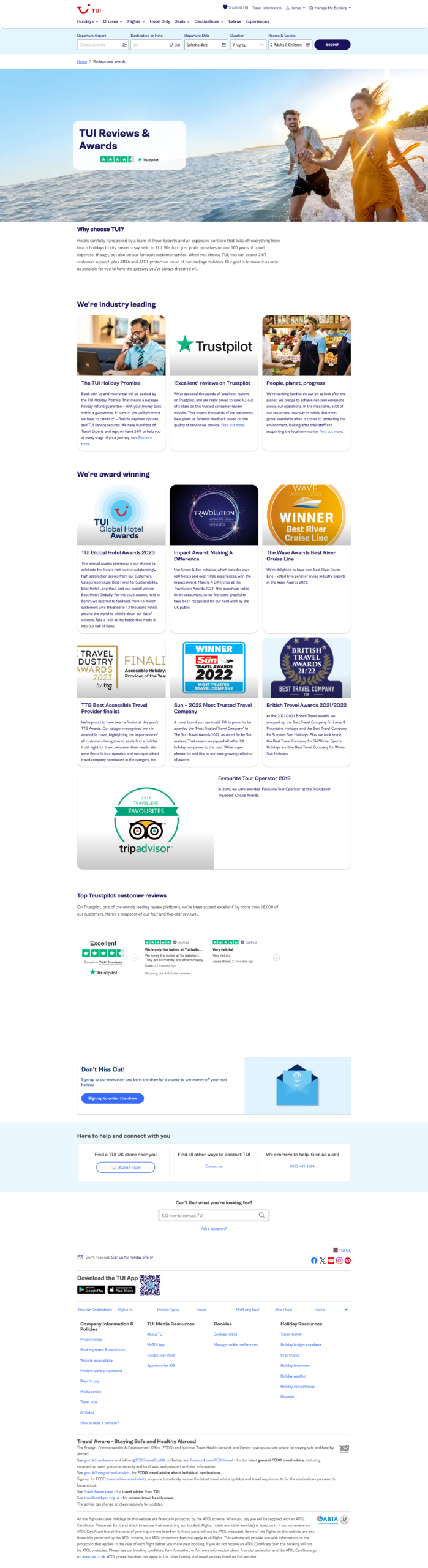
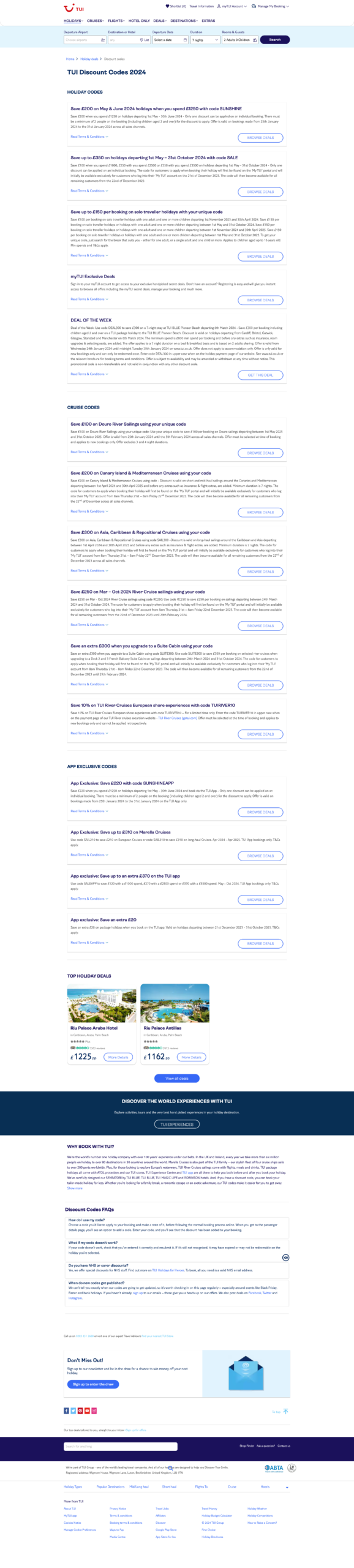
At the end of the day, you’ve got an opportunity to control what potential customers see when they look for a discount or seek to learn more about your brand or service.
On your discount codes page, be sure to share live deals. If you offer no discounts and always have the best prices direct, then say that.
On your reviews page, embed the best reviews from platforms like Trustpilot, and share any awards or accreditations. This is a real opportunity to showcase the best bits that others have said about you.
Step 2: Create content that matches search intent
One of the biggest mistakes travel brands make is producing content based on what they want to say, rather than what users actually want to find.
Before creating any page, look at what is already ranking in Google and analyse the intent behind the search. The current SERPs will tell you a lot about what users expect to see and the type of content Google believes best answers the query.
For example, if you want to rank a hotel listings page for “Hotels in Orlando”, look closely at the pages that already rank. Are they purely hotel listings, or do they also include destination guides, local area information, hotel types, FAQs, map features, and links to more specific searches?
You should never copy what already exists, but you do need to understand the level of depth, structure, and supporting information required to compete.
Step 3: Use internal experts to add real value
The best travel content is built on genuine expertise, not just keyword research.
Speak to the people in your business who know destinations, travellers, and common customer questions better than anyone else. That could mean travel advisors, destination specialists, customer service teams, sales teams, or even tour guides.
These people can help you understand what travellers are actually worried about, what they want to know before booking, and which questions come up time and time again.
That insight helps you create content that is more useful, more original, and more valuable than what already ranks.
Step 4: Focus on creating the best result, not the longest
Travel content does not need to be long for the sake of being long. Sure, sometimes it does need to go into a lot of detail to cover a topic in full…but this isn’t a blanket rule.
There is still a tendency to assume that more words automatically lead to better rankings, but that is no longer true. A 500-word page that answers a traveller’s question clearly and effectively can easily outperform a 5,000-word page full of repetition, filler, and irrelevant fluff.
Instead of focusing on word count, focus on usefulness. Ask yourself:
- Does this page answer the key questions a traveller has?
- Does it help someone make a decision?
- Does it offer something more useful than the pages already ranking?
- Is every section genuinely adding value?
Sometimes, less content, presented in a clearer, more helpful way, performs much better.
Step 5: Support your content with trusted sources
Travel content often benefits from supporting data, local information, regulations, weather patterns, safety advice, or statistics.
When you reference information from another source, link to it.
There is no SEO benefit in withholding links to trusted external websites. Linking to authoritative sources can improve the credibility of your content, enhance the user experience, and strengthen trust signals.
For example, you might link to tourism boards, government travel advice, weather services, transport operators, attraction websites, or official statistics.
Step 6: Use original, high-quality images wherever possible
Travel is an inherently visual industry, and imagery can play a major role in how users engage with your content.
Whenever possible, use your own photography rather than relying entirely on stock imagery. Original photos can help your brand stand out, make your content feel more trustworthy, and give users a more realistic sense of a destination, hotel, or experience.
This is not always easy, particularly at scale, but even adding a small number of unique visuals can make a noticeable difference.
Step 7: Write naturally, not for keywords
Sure, aligning content with how people search is still important, but keyword stuffing has no place in modern travel SEO. Or in any industry-specific SEO, for that matter!
You do not need to force the same phrase into every heading, paragraph, and image alt tag. In fact, doing so often makes content harder to read and can harm the user experience.
If you have a clear understanding of the topic, the search intent, and the information users need, relevant keywords and phrases will naturally appear in your writing.
Prioritise readability first. Write in a way that feels useful, clear, and natural for the user.
Step 8: Make value the priority on every page
Above all, the goal should be to create the best page possible for that topic.
Every piece of travel content should offer something genuinely useful, whether that is helping someone discover a destination, compare accommodation options, understand local transport, or plan a trip more confidently.
The brands that perform best in travel SEO are usually those that consistently focus on creating content that is more useful, trustworthy, and complete than what already exists.
On-page SEO for travel websites
On-page SEO is a foundation of any successful travel SEO strategy.
Travel sites often compete across huge numbers of destinations, properties, routes, guides, and informational topics. That means small improvements to page templates, headings, internal links, and URLs can have a significant impact when rolled out across hundreds or thousands of pages.
While great content is essential, on-page SEO is what helps search engines understand your pages and gives them the best chance of ranking.
Step 1: Optimise title tags for rankings and clicks
Title tags remain one of the most important on-page SEO elements.
They are usually shown as clickable headlines in search results and play a major role in both rankings and click-through rates. If your title tags are not properly optimised, you are unlikely to perform as well as you could.
Every title tag should:
- Include the page’s primary target keyword
- Place that keyword as close to the start as possible
- Clearly explain what the page is about
- Give users a reason to click
For example, a title tag such as “All Inclusive Holidays to Greece 2026/2027” works because it includes the core keyword, clearly describes the page, and adds useful context around booking years.
You should also consider what will make your results stand out from competitors. This could include:
- Pricing information
- Availability
- Number of hotels, resorts, or properties
- Unique selling points
- Seasonal relevance
- Special offers
Google increasingly uses click behaviour as a signal, so title tags should be written for users as much as search engines.
Step 3: Use meta descriptions to improve click-through rates
Meta descriptions are not a direct ranking factor, but they still matter.
They are often displayed below the title tag in the search results and can influence whether someone clicks on your listing or a competitor’s.
A strong meta description should:
- Include the main keyword naturally
- Highlight what is unique about the page
- Reference important selling points
- Include a call to action, where relevant
For travel sites, that might mean mentioning things like:
- Exclusive deals
- Range of properties or destinations
- Free cancellation
- Flexible booking
- Customer reviews
- Popular amenities
- Seasonal offers
Think of meta descriptions as ad copy for your organic listings. Their job is to convince users that your page is the best result to click.
Step 4: Keep H1 tags clear and consistent
Your H1 should clearly describe the page’s main topic.
In most cases, the H1 should closely align with the primary keyword target. For example, if the page is targeting “All Inclusive Holidays to Greece”, the H1 should simply be “All Inclusive Holidays to Greece”.
There is rarely a need to overcomplicate this.
As a best practice, my advice is to:
- Only ever use one H1 per page (more confuses search engine crawlers, which can compromise rankings)
- Include the primary keyword
- Make sure it accurately reflects the page content
- Keep it unique across the site
Avoid reusing vague H1s such as “Travel Guide” or “Our Destinations” across multiple pages. Each page should have a distinct heading that clearly explains its purpose.
Step 5: Structure content properly with H2-H6 tags
Heading tags do more than just break up content visually. They help search engines understand a page’s hierarchy and structure.
H2s should be used for the main sections of a page, while H3s, H4s, and lower-level headings can be used to break these sections down further where needed.
For example, on a destination page, you might use:
- H2: Best Time to Visit
- H2: Things to Do
- H3: Beaches
- H3: Restaurants
- H3: Family Activities
- H2: Where to Stay
This structure makes content easier to read, easier to scan, and easier for search engines to interpret.
Where it feels natural, include relevant keyword variations in your headings, but do not force them in unnaturally.
Step 6: Built clean, descriptive URL structures with consistent subfolders
URLs should be simple, descriptive, and easy to understand.
A clean URL helps both users and search engines understand what a page is about before they even click on it.
For example:
- travelwebsite.com/destinations/europe/greece
- travelwebsite.com/hotels/florida/orlando
- travelwebsite.com/guides/best-beaches-in-thailand
This is far more effective than vague or messy URLs such as:
- travelwebsite.com/page123
- travelwebsite.com/category?id=89
- travelwebsite.com/best_beaches_thailand
Some key URL best practices include:
- Use hyphens rather than underscores
- Keep URLs lowercase
- Avoid unnecessary words
- Keep them as short as possible while remaining descriptive
- Follow a consistent structure across the site
- Avoid special characters and parameters where possible
For larger travel websites, URL structure also plays an important role in reinforcing site architecture and topical relevance.
Step 7: Plan topic clusters around destinations and travel types
From experience, I can tell you that travel SEO works best when your site is organised into clear topic clusters.
This means grouping related pages around a broader topic rather than treating each page as an isolated asset.
For travel sites, topic clusters are often built around:
- Destinations
- Travel styles
- Accommodation types
- Activities
- Transport methods
- Seasonal travel
For example, a broad destination page for Florida could link to supporting pages around Orlando, Miami, Key West, theme parks, beaches, restaurants, and family activities.
This creates a much stronger signal to search engines that your site has depth and authority on the topic.
A typical cluster might look like:
- Florida Holidays
- Orlando Holidays
- Best Hotels in Orlando
- Things to Do in Orlando
- Best Restaurants in Orlando
- Orlando Theme Park Guide
This type of structure helps search engines understand the relationship between pages and improves your chances of ranking across an entire topic area, rather than just for one keyword.
Step 8: Use internal linking to strengthen rankings
Internal linking is one of the most underused SEO tactics on travel websites.
Travel sites naturally have huge opportunities to link between related destinations, hotel types, routes, attractions, travel tips, and supporting guides.
Internal links help to:
- Pass authority between pages
- Help search engines discover new content
- Reinforce topical relationships
- Improve user journeys
- Encourage deeper engagement across the site
For example, a guide to “The Best Beaches in Tenerife” could naturally link to:
- Tenerife Holidays
- Family Hotels in Tenerife
- All Inclusive Holidays to Tenerife
- Best Time to Visit Tenerife
- South Tenerife Resorts
Anchor text should be descriptive and clearly explain what the linked page is about.
Most importantly, internal links should always feel useful and relevant. They should exist to help users continue their journey, not just to add more links for SEO.
When you publish new content, always go back and add internal links from older, relevant pages. This helps new pages get discovered faster and strengthens the overall topic cluster.
Leveraging digital PR and targeted link-building in travel press
Links remain a core pillar of SEO success, particularly in a competitive industry like travel.
But not all links are equal.
Travel brands should not focus on building links at scale from low-quality sites or on outdated tactics. Instead, the focus should be on earning relevant, authoritative links that improve visibility, strengthen trust signals, and build brand awareness.
For most travel brands, digital PR should be the main tactic used to achieve this.
Digital PR sits somewhere between traditional PR and link building. It is about creating stories, campaigns, expert commentary, and content that journalists, bloggers, publishers, and industry websites genuinely want to cover.
The result is not just links, but broader visibility for your brand.
A strong digital PR strategy can help travel brands:
- Earn editorial links from relevant, authoritative publications
- Increase brand awareness
- Drive referral traffic
- Strengthen E-E-A-T signals
- Improve visibility in AI search and traditional search
- Build credibility with potential customers
- Generate social engagement and shares
Travel and digital PR are a particularly strong fit because there are so many opportunities to create stories around destinations, trends, pricing, consumer behaviour, seasonal travel, hidden gems, travel habits, and expert advice.
Step 1: Use a mix of digital PR tactics
Digital PR is not a single tactic.
The most successful travel brands typically use a mix of different approaches depending on the audience they want to reach and the types of coverage they want to earn.
This might include:
- Data-led studies and reports
- Destination rankings
- Hidden gem campaigns
- Seasonal travel insights
- Surveys and consumer research
- Expert commentary
- Reactive PR linked to trending news stories
- Product or service launches
- Brand storytelling
- Travel tips and destination advice
For example, a travel brand could create a campaign around the best hidden beaches in Europe, the cheapest family destinations, the most walkable cities, or the best places to visit in winter.
Equally, they could provide expert commentary on airline disruption, travel insurance, overtourism, visa changes, or rising hotel prices.
The key is to create something that journalists and publishers will find valuable to share.
Step 2: Focus on earning links that also build brand visibility
One of the biggest mistakes brands make is treating link building purely as an SEO exercise.
In reality, the best links often do far more than improve rankings.
Coverage on travel publications, regional news sites, blogs, lifestyle publications, tourism websites, and industry resources can all help put your brand in front of the right audience, drive referral traffic, and reinforce your authority.
A link from a relevant travel website that sends engaged visitors and introduces your brand to new audiences is often far more valuable than a stronger SEO metric from a site with no real relevance.
This is especially important in travel, where trust and familiarity can play a major role in booking decisions.
Step 3: Look beyond digital PR for link opportunities
While digital PR should sit at the heart of your strategy, it should not be the only tactic you use.
Travel is one of the best industries for earning links naturally because there are so many resource pages, travel guides, destination sites, directories, blogs, and “best of” round-ups that recommend businesses, accommodations, attractions, and services.
For example, if you were trying to build links to a “Vacation Rentals in Big Sur” page, there are likely to be opportunities across:
- Destination guides
- “Where to stay” pages
- Local tourism websites
- Travel blogs
- Accommodation round-ups
- Business directories
- Local chambers of commerce
- Attraction partner pages
- Event websites
- Regional publications
Many of these sites actively feature recommendations and link out to accommodation providers, attractions, and local businesses.
In these cases, outreach can be surprisingly effective.
If you can clearly explain why your business deserves to be included, whether because of location, facilities, expertise, awards, customer reviews, or something unique you offer, there is often a good chance of earning a placement.
Step 4: Use relevance as your main link-building filter
Not every link opportunity is worth pursuing.
When assessing whether a link is valuable, think about:
- Is the site relevant to travel or my niche?
- Is it relevant to the destination or audience I want to target?
- Could it realistically send referral traffic?
- Does it strengthen trust and credibility?
- Would this still be a worthwhile placement even if SEO did not exist?
If the answer is yes, it is probably a good opportunity.
If the only reason for getting the link is the site’s high authority score, it is usually not worth it.
Step 5: Avoid low-quality and manipulative tactics
Travel is a competitive industry, which means there is often a temptation to rely on quick-win link-building tactics.
Avoid buying links, excessive guest posting on irrelevant sites, spammy directory submissions, or large-scale link exchanges.
Many travel bloggers and smaller sites may ask for payment in return for coverage or a link. While that can be common in the industry, paying for followed links goes against Google’s guidelines.
Long term, the safest and most effective strategy is to focus on earning links naturally through strong content, useful resources, digital PR campaigns, and relevant outreach.
The travel brands that build the strongest authority are usually the ones that become genuinely visible and useful within their niche, not the ones chasing the highest volume of links.
Technical SEO and trust signals for travel websites
Technical SEO and trust signals are what sit behind the scenes of a successful travel website.
You can create great content, build strong links, and target the right keywords, but if search engines struggle to crawl your site, users do not trust your brand, or your pages load too slowly, you will always be limited in how well you can perform.
For travel brands, technical SEO and trust go hand in hand. Travellers need to feel confident that your information is accurate, your booking process is secure, and your brand has genuine experience and expertise.
Step 1: Use schema markup to improve visibility
Schema markup helps search engines better understand the content on your pages.
By adding structured data, travel websites can become eligible for enhanced search results, such as review stars, pricing information, FAQs, events, and local business details.
These richer search listings can help improve click-through rates by making your results stand out.
For travel websites, some of the most useful schema types include:
- LodgingBusiness for hotels, resorts, hostels, campsites, and holiday rentals
- TouristAttraction for landmarks, attractions, and places of interest
- TouristDestination for destinations, cities, regions, and travel hotspots
- TouristTrip for itineraries, travel packages, and tours
- TravelAgency for agencies, OTAs, and tour operators
- Event for festivals, conferences, concerts, and seasonal activities
While schema is not a direct ranking factor, it can massively improve visibility and help search engines better interpret your pages.
Step 2: Demonstrate E-E-A-T across your site
E-E-A-T stands for Experience, Expertise, Authoritativeness, and Trustworthiness.
These principles matter a great deal in travel SEO because travellers are making important decisions based on the information you provide. They want to know they can trust your recommendations, booking process, and advice.
Experience is often the most important factor for travel brands.
Google wants to reward content that reflects real-world knowledge and genuine experience of destinations, hotels, attractions, and travel types.
There are a number of ways to demonstrate stronger E-E-A-T across a travel website:
- Make it clear who has written or reviewed the content
- Use destination experts or travel advisors as authors
- Create detailed author pages that showcase experience and credentials
- Include personal insights, tips, recommendations, and first-hand knowledge
- Use original photography and video rather than relying entirely on stock imagery
- Make contact information easy to find
- Clearly display reviews, testimonials, memberships, and accreditations
- Build a strong About Us page that explains who you are and why travellers should trust you
- Use secure payment gateways and make trust signals prominent during the booking process
Travel is not as heavily regulated as sectors like finance or healthcare, but trust is still essential… especially if people are considering spending hundreds (if not thousands) of pounds on a single trip.
Step 3: Focus on crawlability and indexability
Technical SEO is ultimately about making sure search engines can crawl, understand, and index your site properly.
If pages cannot be crawled or indexed, they cannot rank.
For travel websites, this is particularly important because many sites contain thousands of pages across destinations, hotels, routes, travel guides, attractions, and blog content.
Common technical issues that can affect travel sites include:
- Broken internal links
- Duplicate content
- Poor canonicalisation
- Incorrect noindex tags
- Thin location pages
- Orphaned pages
- Crawl depth issues
- Pagination problems
- Parameter-based URLs
- Poor mobile performance
Technical SEO is often best thought of as a foundation. It may not always drive growth directly, but technical problems can stop everything else from working as effectively as it should.
Step 4: Improve page speed and Core Web Vitals
Site speed matters for both SEO and user experience.
Travel sites often rely heavily on large images, maps, booking tools, filters, videos, and JavaScript-heavy functionality. All of these can slow pages down if not managed properly.
Google’s Core Web Vitals focus on three key areas:
- Loading speed
- Interactivity
- Visual stability
Some of the biggest opportunities to improve page speed on travel sites include:
- Compressing large images
- Using next-generation image formats such as WebP
- Lazy loading images and videos
- Minifying CSS and JavaScript
- Deferring non-essential scripts
- Using a CDN
- Improving server response times
- Implementing browser caching
Travel brands should regularly review performance using tools such as Google PageSpeed Insights and prioritise improvements with the greatest impact on user experience.
Step 5: Make sure your site is secure
HTTPS is now a baseline expectation for any website.
Travel sites often handle personal details, booking information, and payment data, making security especially important.
If your site still uses HTTP rather than HTTPS, browsers may mark it as “Not Secure”, which can damage trust and affect conversions.
Every travel website should:
- Use a valid SSL certificate
- Redirect HTTP URLs to HTTPS versions
- Update internal links to use HTTPS
- Ensure booking processes and payment gateways are secure
- Use both HTML and XML sitemaps
Sitemaps help users and search engines navigate your site more effectively.
HTML sitemaps are designed for users and provide an overview of important sections and pages.
XML sitemaps are designed for search engines and help them discover, crawl, and index URLs more efficiently.
For large travel websites with thousands of pages, XML sitemaps are particularly important because they help search engines find new destination pages, guides, properties, and blog content more quickly.
Your XML sitemap should update automatically whenever pages are added, removed, or changed.
Step 6: Manage JavaScript carefully
Many travel websites rely heavily on JavaScript for interactive features such as maps, filtering, search tools, booking widgets, and dynamic content.
However, JavaScript can create SEO issues if search engines struggle to render content properly.
Where possible, travel sites should use server-side or hybrid rendering to ensure important content is visible to search engines immediately.
If critical content only appears after JavaScript loads, there is a risk that search engines will not crawl or index it properly.
This is especially important for:
- Property listings
- Hotel filters
- Destination content
- Booking widgets
- Reviews
- FAQs
- Internal links
Step 7: Optimise for Google Discover
Google Discover can be a valuable traffic source for travel brands, particularly for inspirational and informational content.
Travel is naturally suited to Discover because people often browse for ideas, destination inspiration, itineraries, seasonal travel advice, and “best of” lists without actively searching.
The types of content most likely to perform well in Discover include:
- Destination guides
- Travel trends
- Seasonal inspiration
- Hidden gems
- “Best places to visit” round-ups
- Itineraries
- Travel tips
- Newsworthy or timely travel stories
Large, high-quality images are especially important for Discover visibility, as is creating content around topics people are already interested in.
Step 8: Take advantage of free booking links
Hotels and holiday rentals can also improve visibility through Google’s free booking links.
These appear in Google Hotel Search and let users book directly with a hotel or property, rather than going through an OTA.
For smaller hotels, resorts, and holiday rentals, free booking links can be a valuable way to increase direct bookings and reduce reliance on third-party platforms.
To qualify, properties usually need to work with a Google-approved connectivity partner that can provide real-time pricing and availability data.
For travel brands that rely on bookings, this can be an important additional visibility opportunity alongside traditional SEO.
Measuring travel SEO success
If you’re investing in your travel site’s organic growth, you need to know how to track this and what success looks like.
But it’s important to recognise that measuring and reporting success isn’t just about understanding your ROI.
Not at all.
It’s as much about being able to identify what is and isn’t working so that you can double down on those things that are driving growth and shift up your strategy when you’re not seeing the impact you expected.
So, what metrics should you be tracking?
- Organic bookings/revenue: This is the ultimate measure of travel SEO success is bookings and revenue. Track the number of bookings and revenue generated from organic search traffic, with this directly reflecting the financial impact and ROI of your SEO efforts.
- Organic traffic: Monitor the number of visitors visiting your site from organic search. Google Analytics (GA4) can help you track this.
- Keyword rankings: Track how your priority keywords are ranking on the SERPs. Use tools like SEMrush or Ahrefs to set up rank tracking, or choose a dedicated tool like SE Ranking, Accuranker, or SEO Monitor.
- Organic impressions: Measure how often your site appears in search results as impressions in Google Search Console. Tracking impressions and seeing an increase here is often an early indicator of growth.
It’s not just about tracking these things, though. What matters is how you use this data.
Analyse these metrics regularly to identify trends and patterns. If certain types of content or specific tactics are driving traffic and bookings, double down on them and allocate more resources to those areas.
Conversely, if some efforts clearly aren’t having an impact on results, shift your strategy.
There’s nothing wrong with pulling back on something that’s not working.
Regularly reviewing and understanding your SEO metrics helps you to make informed decisions, focusing your efforts on continuous growth and improvement in your site’s organic performance.
Are you ready to make SEO a growth engine for your travel business?
Investing in SEO is a must for travel brands aiming to diversify their marketing efforts and leverage the significant traffic and booking potential from search engines. And what we’ve seen is that even mid-tier travel websites can attract significant non-branded organic traffic, translating to high-value bookings. The potential ROI from organic search is immense, making SEO an essential growth channel that travel marketers shouldn’t ignore.
But a successful SEO strategy must be tailored to the specific needs and goals of every travel brand, whether it’s an OTA, boutique hotel, or large resort group. This involves understanding how to pull the right levers across technical SEO, content and link building to achieve results.
The key to leveraging SEO lies in understanding and navigating the unique challenges of the travel industry, from competing against OTA giants and Google itself to addressing seasonality and lengthy customer journeys. But yy focusing on creating valuable, well-structured content, building strong technical foundations, and earning high-quality backlinks, travel brands can enhance their visibility and drive organic growth.
Ultimately, SEO is not just a marketing tactic but a growth engine for travel websites, offering a scalable and sustainable way to attract, engage, and convert searchers into guests. As the competitive landscape continues to evolve, staying ahead with a strategic, well-executed SEO strategy will be crucial for travel brands aiming to thrive in the market.