



Black Friday is of course one of the biggest events in every company’s marketing calendar – for months leading up to the big day (which is pretty much the whole of November these days!), businesses are busy readying their deals and aligning across social, email, paid and all other channels.
But Black Friday often gets overlooked from an SEO perspective.
Many companies often think that this is an opportunity to shout about their big deals and draw customers in – which, of course, it is. But consumers are also eagerly waiting for Black Friday, using our old friend Google to search for the best deals.
It’s our job to meet them there.
When done well, Black Friday can be a massive driver of success from an SEO perspective, with organic supporting every other channel to make Black Friday better than ever.
But like everything, that takes careful planning. Here’s how to build towards Black Friday SEO success.
Tip #1 – Plan as early as possible
As we’ve said already, Black Friday is no longer just a day. Deals are spanning the whole of November, and your competitors began planning six months ago.
As an SEO, it’s a good idea to know your Black Friday strategy inside out as early as possible – whether you work in house or for an agency. As your clients or internal teams questions like:
- When are we starting to promote Black Friday?
- What deals do we have?
- When do our deals go live?
- What are our stand-out discounts?
- Are there any specific products, categories or brands that are a focus for us?
Knowing your deals inside out allows you to prioritise and plan effectively. If you’re a small company, this may be more straightforward – but if you’re a large retailer stocking different brands and products, this approach will help you to focus your efforts and see that maximum success.
If you’re working in digital PR across Black Friday, you can have your outreach calendar planned far in advance – knowing when your offers are going live allows you to outreach at the earliest opportunity (and you can even offer exclusives to your dream publications too).
Tip #2 – Understand your audience
At this point, “understand your audience” should be a catchphrase of mine.
But for good reason – it applies to almost every area of SEO (and marketing in general) – Black Friday included. You need to understand how your audience are searching and meet them there.
You might think it’s as simple as targeting the keyword “black friday” – but it’s a lot more nuanced than that. Your customers could be searching for:
- [brand] black friday deals – e.g. “argos black friday deals”
- [brand] [category] black friday deals – e.g. “argos black friday tech deals”
- [brand] [subcategory] black friday deals – e.g. “argos black friday phone deals”
- [brand] [product] black friday deals – e.g. “argos black friday iPhone 15 deals”
- [category] black friday deals – e.g. “black friday phone deals”
…and there are plenty more options that I’ve not listed here, too.
Are your customers are searching directly for your brand (more on that to come) or are they’re shopping around? Are they looking for specific products? Or looking for whatever they can get the best deal on?
These insights will help you meet your potential customers exactly where they are right now, rather than where you want them to be. You can get this insight using last year’s data (have a look on Semrush or Google Search Console to see what drove traffic), by looking at competitors, or by speaking to customer service teams or teams in wider marketing channels.
Once you’ve got these insights nailed, you’ll have a clearer idea of where you want to be driving your Black Friday traffic to. If you’re a smaller business, or a business specialising in just one type of product, it might be best to have one dedicated Black Friday page (or you can even drive traffic to your standard Sale page).
On the other hand, larger retailers with products spanning might benefit from multiple Black Friday subcategories. If you sell tech, toys and beauty, a single page is unlikely to meet the search intent of your tech shoppers, your toy shoppers and your beauty shoppers. And you’re unlikely to rank for your highest-value, most relevant keywords.
Knowing where you want to drive that traffic to (and making each page as helpful as possible) is key. If insights tell you people are searching for specific brands you stock, you might benefit from standalone pages for each. But if you’re a toy retailer and you find out people are just searching for “black friday toys”, one page should be just fine.
Tip #3 – Own your branded search terms
Owning your brand’s SERP is one of the biggest SEO no-brainers out there, and is such an easy thing to implement.
If you’re a large(ish) e-commerce brand, your customers (and potential customers!) are going to be regularly searching for terms along the lines of:
- “[brand] discount code”
- “[brand] reviews”
- “[brand] vs [competitor]”
…and, at this time of year, “[brand] black friday”.
If you’re not dominating the SERPs for these kinds of keywords, you’re handing money to affiliate voucher sites and letting other sites control the narrative around your brand.
Ranking for all of the above terms should be easy.
Around Black Friday, it’s even more important to own this branded SERP – customers will be looking for discounts from all their favourite brands and will often forgo loyalty to spend with whoever gives them the best saving. By dominating the SERPs for “[brand] black friday deals” and “[brand] discount”, it gives you a place to shout about your deals from the rooftops and silence the competition.
Tip #4 – Support your strategy with Digital PR
Hopefully, brands aren’t still sleeping on digital PR this Black Friday.
It’s one of the most effective ways to a) build links to your product and category pages and b) earn some of the most relevant, valuable referral traffic you’ll ever receive, directly into your best deals.
And if you want to maximise SEO success for Black Friday, digital PR outreach is a non-negotiable.
This particularly applies if you’re creating a brand-new Black Friday page for your site this year that doesn’t yet have much authority behind it or is struggling to rank. But it works both ways – having a dedicated Black Friday URL is a a great way to encourage journalists to link to your site and cover your deals, while earning links to this page will help you rank for those all-important Black Friday keywords.
Our Head of Digital PR, Chloe Bennett, also has some amazing tips for Black Friday digital PR success. Chloe recommends collating a master media list of contacts and having a dedicated team to work solely on Black Friday, particularly if you’re in an agency. It’s one of the busiest times of the year and not just for PRs, but for journalists as well. Journalists receive hundreds, if not thousands, of emails daily, so having a master media list set up and a dedicated Black Friday team means you’re building those all-important journalist relationships, which will help secure links and coverage at scale. And again, get your planning and outreach started as soon as possible – it’s getting earlier and earlier each year.
Tip #5 – Nail your product visibility
Anyone with an internet connection will have noticed the changes on the SERPs over the last 12 months. AI overviews and other feature changes aside, we’re seeing more and more prominence given to organic shopping listings on Google – so you need to make sure your brand is being showcased here, as well as across the standard blue links.
Organic product grids, merchant listings, shopping carousels, or “popular products” (as Google prefers to call them) – whatever you’re calling these free listings on Google, they’re not something to be ignored. There are a couple of simple steps to maximise your chances of appearing here.
Ensure you’re able to appear
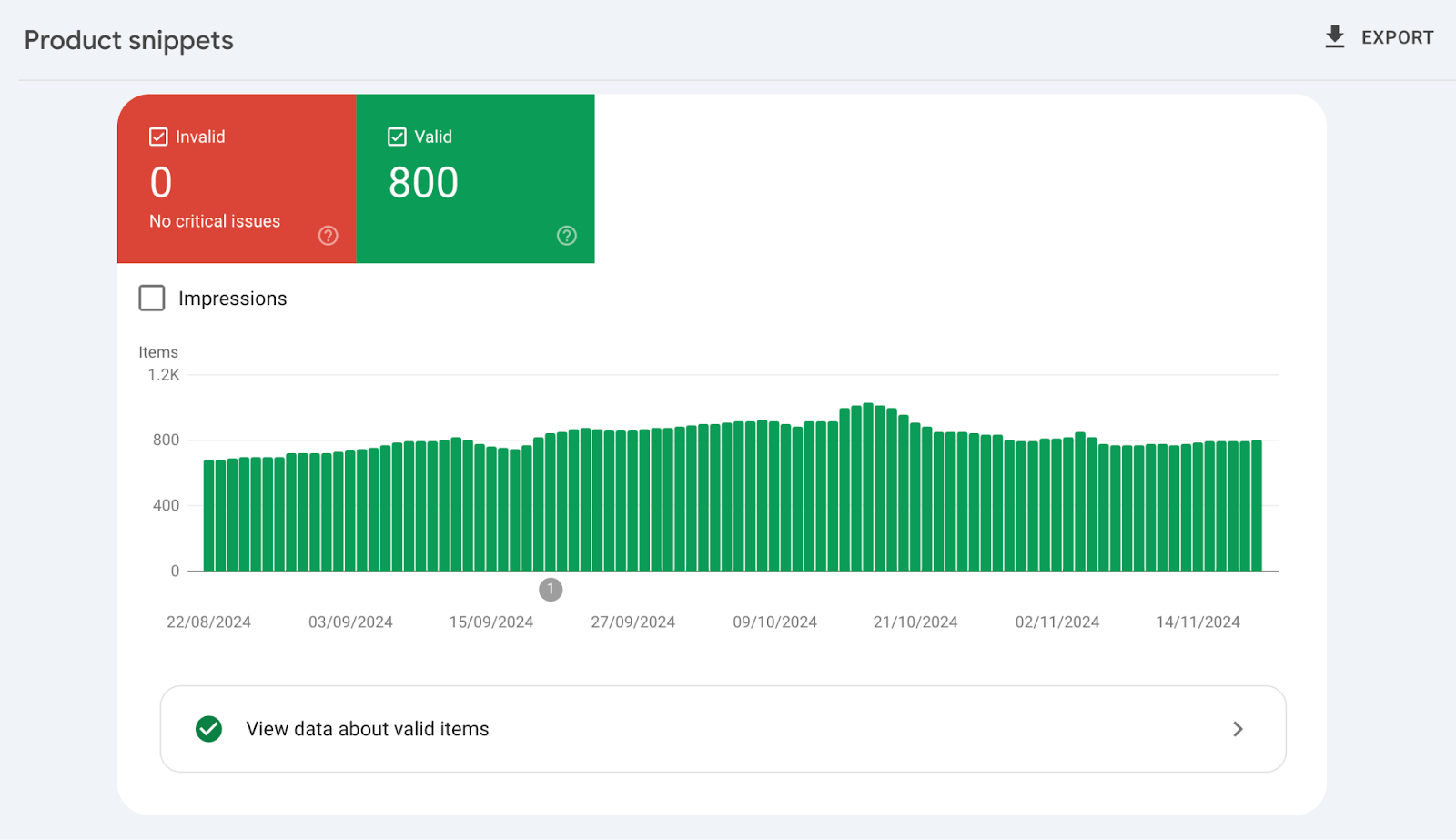
The data from these organic shopping listings feeds in from Merchant Center, so step number one is ensuring you have this correctly set up. You can then also use Google Search Console to identify the number of valid items and if you have any issues with your setup that may impact your visibility.
Next: optimise!
Ranking in these product grids is a much more nuanced strategy, as you may expect, and there are plenty of detailed guides on organic shopping listings across the internet that can help on this.
But for our purposes of improving your product visibility around Black Friday, the main thing to highlight is making sure you’ve included all the information that might help Google to identify and showcase your products effectively. This covers both structured data on the page and information within Merchant Center itself, looking at things such as review data, stock information, delivery details, and – most importantly for Black Friday – deals and discounts.
Bonus tip – Have fun with it!
And finally, have some fun with your Black Friday planning! This is the time of year to stand out from the crowd, so get experimenting with your boldest page titles and attention-grabbing subject lines for digital PR outreach.
All of these tips will help you plan for and win at Black Friday – by thinking ahead, understanding your audience, and meeting them where they’re searching. This will allow you to maximise your organic visibility, giving you the most successful Black Friday yet – across every single channel.